Showing posts with label sustainable. Show all posts

Saturday, December 1, 2018

What in the winter?

I realised after having a dream that I found a whole other part of my house to renovate, that I really miss renovating! I love taking something ugly apart and turning it into something useful. But unfortunately, I don't have another house to renovate.
I set my sights instead on my basement. Practicing minimalism hasn't quite prevented me from collecting some treasures down there. The trouble with treasure is, if you aren't able to use it, it has no value. 
Two years ago I bought this old gun box. I have a thing for boxes. I especially love big chests (get your mind out of the gutter).

This old gun box had been turned into a shelving unit by the person who had it before me, and painted a dark brown.

Also in the basement: table legs and two perfectly good, but out of fashion, stools that I picked up from the curb.

A bit of sanding to remove the paint and suddenly the hand carved celtic cross stood out beautifully.

The cross being on the door meant that when the door was open I wouldn't be able to see the cross. I took the door off, and flipped it.

After adding the legs and a bracket for stability, I had a pretty cool bar! I moved onto painting the bar stools and five hours later, voila!

A breakfast nook from salvaged materials.

Monday, November 5, 2018

Anti-consumerist weekend

As regular readers of the blog (and friends who have heard my unprovoked rants) may have guessed, I am opposed to consumerism for the sake of consumerism.

My house does not look like the houses that pop up when you search "minimalism", though. I painted my walls bright colours which repulse people with dark souls, and every wall is covered with a generous amount of rescued or self-made art. All my frames are rescued from bins or relative's basements and it turns out, you can put anything in a frame and it looks like art. 

Being anti-consumerist doesn't mean you can't own stuff. Fighting consumerism is a conscious choice; everything in your house has been reflected upon. Every picture, plant pot, bowl, cat, and computer has been invited into my home after much deliberation. I don't go shopping and buy something unless I have a need for it and have already researched alternatives to that thing, or that thing second hand. This probably sounds like a lot of work to people who love going shopping and coming home with an empty bank account but lots of pretty new things to store in the closet and never look at again.

It is easier to buy without thinking than it is to walk through rows of cheap goods and only buy the one thing you need. It's harder to go to the hardware store and find the part to fix whatever is broken than it is just to buy a new thing. Just remember, every time you spend $80 on stuff you didn't need, that's another day you have to keep working that job you hate (if you don't hate your job, awesome!). 

I live happy in the knowledge that my actions are in line with my world view. We make too much stuff, throw out too much stuff, and if we could all take one day off work per week we would be less stressed and make more conscientious choices. If life isn't so hectic, you can take time to pause and ask yourself "do I really want this?"  (This applies not only to stuff, but relationships and lifestyles!)

If you really want to unwind next weekend after your stressful week at work, instead of shopping, try to turn something you already have but kind of hate into something that is brilliant. Pinterest is full of awesome ideas to turn junk that's sitting in your basement into something artistic and fun. And if you still hate it, no problem! You were going to get rid of it anyway. If you love it, you can feel good that you got a cool new thing without spending any money and without consuming more precious resources and destroying the planet for future generations. Bonus points if you learned a new skill and increased your confidence in your own abilities!

Well done you!

Sunday, September 30, 2018

Summer of Market, Photo Diary

Nobody got into farming because they liked record keeping. One short-cut form of record keeping is taking photographs. These photographs serve to remind me when certain items came in season, and remind me visually what I had on offer on the weeks when I had the highest, and lowest sales. 

Here is some of Eden's Rise first year at the market, in easily digestible form. There are three weeks left, come to Metcalfe Farmer's Market Saturdays 9-1 to say hello!
July 28
August 11
August 25
September 1
September 8
September 22

Tuesday, June 12, 2018

Growing Orchard

Changing the pH of the soil is slow business, but the blueberries continue the fight. Enough flowers this spring to feed my hungry face with blueberries this summer! Maybe next year the soil+age of the plants will = surplus available for sale!
Grapes have been unimpressive in my poor soil, but this year their roots finally seem to have established some dominance against the stubborn grass. After two years, we see some top growth. (Grape plants have since been weeded)
The orchard will produce its first grapes!
The lonesome Kiwi survives. Two of her sisters and her mate have died. Without a male, these plants cannot produce fruit.
One of five blueberry varieties in the orchard.
There will be a huge amount of currants coming my way! I am excited to have a crop to harvest. Growing perennials is a game of patience, seeing results is a gift. One of 50+ currant bushes at the orchard...yum!
A few Haskap/honeyberries have already ripened. Unfortunately the 30 plants I planted last spring have produced collectively 8 berries. Here's hoping next spring will prove more rewarding. In the meantime, I have planted a further 25 haskap plants this spring and continue to propagate new plants from cuttings.
Saskatoons ripening in the sun. I purchased two varieties of Saskatoon. Lee 8 (pictured here) is producing fruit on every plant. The Martin variety has not produced a single berry.

Sunday, March 11, 2018

Minimize that Wardrobe

It is said that we use 20% of our belongings 80% of the time. Despite practicing minimalism for the past year, every week I find more items that have so far evaded my minimizing purges. Every time I think I have nothing left that I could live without, I find myself staring at a piece of furniture or a knick-knack and imagining life without it. Inevitably, it's the next thing I get rid of and the cycle continues.

My 'decluttering' is usually pretty unfocused in nature, and I never developed a system beyond It Must Be Beautiful, Bring Me Joy, or Useful. This system works less well on minimizing a clothing collection. I still have duplicates of black sweaters, farm work jeans, tank tops, etc. 

Until recently I moved every 6 months, and traveled a lot. All my clothes fit in a backpack that wasn't heavy enough to burden me. The climate was not as harsh as Canada, so I didn't need long-johns, snow pants, winter coats, mittens, etc. Mostly I lived in Scotland where summer clothing was equally unnecessary, so no need for summer dresses, multiple bathing suits, or shorts.

Remembering my slightly nomadic existence inspired me to go through my wardrobe as if I still lived that way. Considering my current circumstances I asked of each item of clothing:

If I was going on holiday for several months, somewhere where temperatures ranged from -30C to +30C and I was planning on working on a farm while I was there, would I bring this with me?

It occurs to me that this formula could help others declutter and return clothing into circulation. All you have to do is alter the details within the commas according to what your life and climate look like.

Suddenly it made a lot less sense to hold onto some of the 'just in cases' that have survived monthly clothing purges. 

Perhaps the same trick can help you on your way to living more lightly.


Friday, November 17, 2017

Holiday Gift Giving Guide!

It's mid-November, so naturally everyone is losing their minds about Christmas. I thought I would write a quick no-nonsense guide to gift giving.

1. Ask someone if they want a gift.

This sounds very unromantic, but frankly a lot of people I know would prefer their relatives and friends stop giving them gifts. 

Those of us who have a healthy income can purchase what we need/want when we need/want it. Receiving a throw pillow shaped like an owl might be your idea of an excellent gift, but the person receiving might not actually want another pillow, or a pillow that doesn't fit with their style or colour scheme.

On the flip side, when you have a limited income gifts can be also be a burden. You likely are not able to afford to live in a large space to fill with stuff. My experience with uncertain employment involved me moving apartments every 6 months, extra stuff would have been no gift at all. 

2. If the answer to number 1 is yes, ask what they would like.

Again, this eliminates the element of surprise, fine, but even as a kid going out to choose my own Christmas presents was hugely exciting. The anticipation of knowing added to the joy of unwrapping them several weeks later.

Think about it, when someone gives you a gift out of the blue there is stress involved in receiving it. When you open it, no matter what it is, you have to look delighted in order to make the giver feel appreciated.  Opening a gift when you've told someone what you want is much easier. It's good to give people a few options so that they choose what is appropriate to their budget. Knowing what someone wants doesn't take away from your ability to be thoughtful. It's thoughtful to take the time to ask.

If you have children, this is also a good opportunity to introduce the idea that maybe if they have enough stuff that they would like an experience as a gift. Like a rock-climbing lesson, or taking their two best friends out to see a movie.

3. Whatever the person's answer to 1. or 2., respect it.

The expectation that someone needs to love a gift that you give them is unhealthy. If a man buys a woman a drink in a bar, does she owe it to him to thank him so much for his generosity? No. She doesn't even have to drink it. Why would you expect any different from your loved ones?

Consent is something we undermine constantly in our culture. If someone doesn't want a gift and you want to get them one anyway, at least give them an out. They don't want to hurt your feelings, but by virtue of ignoring their wishes, you are hurting theirs. At the very least mention "I really loved this, and I know you didn't want a gift so no pressure at all. If you don't like it, just give it to me and I will happily have this in my house." Certainly do not make them feel guilty 6 months from now when you don't see that sculpture of a dog sitting proudly in the middle of their living room.

4. Zero Waste gift ideas

A lot of items we buy as gifts come with a lot of packaging- I like to say 'no thank you' to having my food  or soap wrapped in garbage! Here is my favourite stocking stuffer gift idea: jars of treats. Glass jars come in various sizes and can be taken to a bulk food store and filled with smarties, chocolates, dried mango slices, cranberries, gummi worms, nuts, whatever! My godmother last year gifted me two decorated mason jars with cake and brownie mixes inside!

Glass, metal, and paper/cardboard are very easy to recycle and compared to plastic much less wasteful and toxic to the environment. Gifts in these kinds of packages are preferable. 

Glass bottles? Think wine, spirits, maple syrup, olive oil and balsamic vinegar. 

Experiences of all shapes, sizes, and budgets are out there, be creative!


5. Wrapping Without Waste

My family has been re-using gift bags for so long, I don't remember ever buying a gift bag.  If you haven't already got a collection of gift bags in your closet or holiday trunk, then I usually wrap a gift in cloth. If it is material that I particularly want back then I mention that to the recipient. Usually people offer it back anyway. Other alternatives exist, like using the pile-up of re-usable bags that you have as gift bags, but I leave that to your own creative minds.

6. Relax. 

Enjoy the holiday with people who you love and stop making something that is about life, love, and family, into something about consumerism. Happiness comes from within.

E

Sunday, October 8, 2017

Gardening for Butterflies

After my last post I received an excellent question: apart from leaving milkweed in my garden, "How else can we encourage the monarchs?"

Milkweed is known to be critical for monarchs as it is the only  plant upon which monarch caterpillars can feed. The adult monarch butterfly however, can feed on any nectar producing flowers. If you want to give them a nutritious pit stop, plant flowers in groups. This allows butterflies to hop from one flower to another using relatively little energy while getting a full meal. 

Here are five great flowers for attracting butterflies.

Coneflower

Purple Coneflower


Aster
Aster


Black Eyed Susan

Black Eyed Susan


Bee Balm

Bee Balm


Lupine

Lupines


This is a beginner's guide as the truth is any flower/plant is useful as a habitat or source of food for an insect. Clumps of grass are great shelter during rough weather, for example. There are flowering charts and extensive lists of flowers and plants that attract butterflies for those who want to be meticulous.  If you aren't interested in having a binder of study material rest assured that having a diversity of plant species is guaranteed to attract winged visitors. Hummingbirds will certainly be attracted by the red flowers of your bee balm.  The only way to go wrong when planning a butterfly garden would be to create a lawn or to use pesticides. 

Biodiversity is the best thing you can offer. Try having perennial flowers that will flower at different times during the season, so that there is always a nectar source. Indigenous weeds are awesome when your gardening budget is low, letting them grow to flower before pulling them up is a great way to create a mini habitat with a huge amount of biodiversity. Indeed, these plant might be host plants for caterpillars from other species of butterflies.

Simply put: have a garden! Your garden is a space you are sharing with wildlife and insects. It is a refuge for these species from the acres of conventional fields and from the pavement and buildings that cover our cities and suburbs. 

Lastly, do them one huge (obvious) favour; don’t cover the plants and soil with pesticides and herbicides. The land might be in your name, but the earth cannot belong to a person. Animals and insects constantly have their food poisoned for something as superficial as a 'perfect' rose bush.

Go forth and make Eden rise! Really, it is that easy.

Friday, September 22, 2017

Milkweed

Milkweed flower
It is important for the survival of the monarch butterfly that there is a 'milkweed highway' from Canada all the way down to Mexico. This is because milkweed in the only plant on which monarch caterpillars feed. Growing milkweed does not have to be just for this reason. The flower is attractive and the smell is strong, which makes it an appealing nectar source for other insects as well. Honey bees can harvest the nectar for their honey, solitary bees, and other butterflies come feed too.


Monarch caterpillar
The most fascinating part of my milkweed education was learning that it is food for humans too! I love all things edible, and as an environmentalist farmer I like finding perennial food sources that don't require any digging! 

Here is what I learned from a book called Backyard Foraging by Ellen Zachos:


Young milkweed shoots are tender and can be harvested when they are 6 to 8 inches tall, just snap them at the base. Then, remove the mature leaves but leave a few immature leaves at the top of the stem. To eat milkweed, you need to boil or blanch the plant before cooking with it. This removes the bitter sticky white goo inside. Once it has been immersed in boiling water for 1 or 2 minutes, treat it like green beans. They taste similar to green beans, but better (according to Ellen!).


The unopened flower buds are described as being tastier than broccoli. Harvest when they are still tightly bunched together, green, and golf ball size. Again, you must blanch first. Then try steaming them with salt and serve with olive oil.


The immature seedpods (1 1/2 inches long, inside should be all white- the seeds should not be turning brown yet!) can be harvested and blanched. Then, try them in soups, stews, or stir-fries. 

Eden is a place where we can live from the land without destroying it. What better way than to allow this 'weed' a place in your garden. The monarch gets a place to lay eggs, the bees get a drink of nectar, and you get to try eating one of thousands of plant species we have forgotten.

Fantastic!

Friday, September 8, 2017

The Us Versus Them Bias

At lunch break my colleague expressed sorrow for the people who saved up money for a holiday and had to come home early because of hurricane Irma. Another colleague said yes, but they were lucky because she knows that some people weren't even able to book another flight-- they had to stay for the storm.
I frowned over my lunch and quietly said "yes, it is a shame for the rich people* who have gone on vacation. I think it's probably worse for the people who actually live there."
They immediately agreed, but it hit on a theme I had been thinking of for a few months. 

I remember in middle school we learned about the rainforest in science class. The ongoing destruction of this delicate forest for more farmland. What they didn't teach us was that this farmland was used to grow crops that would feed livestock and that by eating meat we were contributing to the destruction of forest ecosystems. They also didn't teach us that Canada's forests are also continuously being cut down and burned for agriculture. Instead, they taught me that people in these almost imaginary far off lands were less educated than our class of 12 year olds. They were cutting down these precious forests because they didn't know any better. 

By that age I knew enough about Canadian history to know that all the farmland around my school had once been a mature forest. It seemed that if we cut down forests in the past, that was okay, but people cutting down forests now was bad. And since all our forests were cut down a long time ago, we can no longer take any of the blame for ongoing climate change.

Last year I worked as an organic farm inspector. Before I go on, I want to point out that I do believe in organic farming and that all farming should be organic by default. Pouring poison directly on our shared planet and directly on the plants that feed us is frankly horrifying. But here is something problematic I discovered during the course of my work.

In order to avoid the three year transition phase for a conventional field to produce organic food** farmers were clearing forested land in order to plant their organic crop and earn certification in their first year. Because this land had never been farmed conventionally there was no need for a transition period. 

This is the problem when ethics clash with capitalism. Farmers are business people. They want more money for the business. That forest is not generating any income, we need to downsize the parts of the business that do not generate income and expand into new product lines that do. Hence, cut down the forest to produce organic buckwheat, hemp, corn, soybeans. Of course, this goes against the philosophy of organics, but it is hugely wound in our society's way of perceiving money as Good above all else. We worship the thing that makes us slaves.

Blaming people across the world for practices we ourselves perform, and then feeling sympathy for our own when natural disasters (exacerbated by our thirst for carbon and our destruction of perennial vegetation) is all part of the same problem. We see Us as something different than Them.  We are all humans that share one planet. If we could do away with borders, maybe we could see that more clearly. What affects one person in our global community affects us all. 

It can be overwhelming as an individual to realize our way of life is being attacked by capitalism and climate change from all directions, and yet we do have power to change things. Want to fight back against capitalism? Stop consuming more than what you need. Want to reduce your impact on the earth? Stop participating in practices that are known to contribute to climate change. In the meantime, we need to stop blaming the Other and start holding ourselves and our neighbours and our communities accountable for what we have the power to change.


*I know that not everyone who goes on holiday is rich from the lens of someone who lives in Canada. Compared to their neighbours they may not consider themselves rich, but compared to the global community, they are.

**Farmers want to avoid this transition period as the first years of transition have lower yields and as the crop is still considered conventional, they cannot demand the higher prices that make organic production competitive.

Sunday, August 27, 2017

Climate Change

"For more than forty years, the view of the Earth from space has been the unofficial logo of the environmental movement- featured on countless T-shirts, pins, and bumper stickers. It is the thing that we are supposed to protect at U.N. climate conferences, and that we are all called upon to "save" every Earth Day, as if it were an endangered species, or a starving child far away, or a pet in need of our ministrations. [...]


When we marvel at the blue marble in all its delicacy and frailty, and resolve to save the planet, we cast ourselves in a very specific role. That role is of a parent, the parent of the earth. But the opposite is the case. It is we humans who are fragile and vulnerable and the earth that is hearty and powerful, and holds us in its hands. In pragmatic terms, our challenge is less to save the earth from ourselves and more to save ourselves from an earth that, if pushed too far, has ample power to rock, burn, and shake us off completely."


-Naomi Klein
An excerpt from the book This Changes Every Thing - Capitalism vs. The Climate 


Sunday, August 13, 2017

A Better Life

When I visited the village of Barauli, Nepal in April I fell in love with the place. The houses were small, on half acre lots where the land was perfectly levelled and filled using a system of ditches connected to the river ankle deep with water. Rice was growing in perfect rows and women hand weeding the fields, barefoot. 

Through the streets there were women walking their small herds of goats, or water buffalo. Many of them wear dresses in vibrant colours- clothes I would never dream of wearing for farm work for fear of getting them dirty! Around the houses there were chicks, chickens, and ducks. I walked all of the streets of that village on my own, everyone said hello as I walked past, and I felt safe and at home and more than anything I wanted to live there.

When I visited a city less than an hour from my home two weeks ago (Perth, Ontario) I was surprised to find it equally appealing, with flowers exploding out of every possible nook and cranny, the main streets are full of stores, pubs, and cafes run and owned by local people. The farmers market had live music and lots of interesting vendors. I wanted to move there too!

The problem with this thinking is that it doesn't allow me to fully appreciate my role in the community where I currently live. If I want my community to become like Perth or Barauli, I have to be part of that change. I have to stop looking with jealousy at what another has and put that energy into turning what I do have into something that is worth appreciating. 

My village has that look of a place which might have at one time been bustling with a lively centre but which has since been slowly dying. The symptom of nearby box stores offering people lower prices along with lower quality of life. 

If I want to live in a place vibrant and alive like Perth or Barauli (without moving there), I need to be the change I want to see in my community. I can make my front yard explode with colour and plant life. I can create a garden that can feed me, and share the excess with my neighbours. I can say hello to everyone I walk past. I can go to the art studio across the street that hosts live music on Sunday mornings to show there is a demand in this little village for affordable entertainment. I can give up the uncomfortably tight waistband of jeans and wear my beautiful dresses that I usually save for 'special' occasions that never come. 

This theme of making our place on earth more beautiful was a big part of my choosing to start Eden's Rise. I chose the name "Eden's Rise" for my orchard because I like that it invokes the idea that this orchard is where the Garden of Eden begins to reclaim the earth. 

I want to invite everyone to take their own journey and remember what is really important to them. Quiet the voice of culture and listen the child that lives within you. The version of you that survives societal pressures to conform. When you think of where in the world you would prefer to be - or what in the world you would prefer to be doing - I want you to really acknowledge those thoughts. Don't push them aside. There's no thought too big to be worth exploring. 

I have started with very small ways I can make my world better today, but I dream of living in a world where women are not still sold into sex slavery, a world where there are no borders preventing people from living in areas where they can find better work, a world where everything doesn't need to be wrapped in plastic, a world where we place more importance on preserving biodiversity than on making profits, a world where we care more about the health of people than profits.

We cannot do the work of improving this world if we don't first imagine what a perfect world looks like. Once we admit there is a problem with the current state of things we can begin to find a solution. Perhaps together we can make our world even just a little more like the Eden of which we dream.


Tuesday, May 30, 2017

Wet Noodles in the Garden

Weeding my asparagus patch this weekend was a joy. Weed a foot, celebrate with a spear, weed another foot, munch some more. Have you ever had asparagus fresh from the ground; raw, crunchy, juicy, and sweet? It was a discovery for me that asparagus could be so delicious. It was more reminiscent of fresh ‘mange-tout’ sweet peas than it was of the steamed spears traditionally laid out sparingly and artistically next to a fancy piece of animal flesh. I ate a dozen out there in the field, slowly burning the skin on the back of my neck.

Once these weeds are out of the way, this asparagus spear is my reward!
As I pulled the weeds up through the mulch I was surprised at the number of earthworms at work in there. When I was digging the holes for my new plants this spring I saw very few earthworms, yet here beneath an inch of grass they were having a huge party on the surface of the earth.

Everyone knows worms are meant to be a sign of a healthy soil. I wanted to take a moment of your time to talk about what it is these fleshy noodles actually do.

Worms live in the ground, of course. Like rodents, they like to keep a door to the outside world in their domicile. From this hole they reach out and grab at decaying organic matter. You can see evidence of this in fields where debris is left in the fall. It looks like many consecutive circles, each circle being the territory around a worm’s hole.
They eat this organic matter and defecate in their hole, deeper in the soil. This way nutrients are spread throughout the soil profile. This organic matter, now worm casts, contains nutrients that are more easily available to the plants thanks to Mr. Worm’s digestion.

The tunnels created by the worms also have positive effects. They aerate the soil, and create conditions for better drainage and water infiltration.  The channels also provide an easy avenue in which plant roots can travel deeper in the soil to find further sources of water. Even their wee, noble bodies decompose and provide nitrogen for the plants. A healthy population of earthworms can actually build topsoil, by how much seems to vary from one study to another. This is excellent news for me on my site, where the topsoil is a mere foot before reaching pure bedrock.

I will end on a darker note. The earthworm is not native to Canada. It appears its presence

is having a drastic impact on the ecology of our old growth forests. National parks advise people to avoid dumping left over earthworms from fishing trips in the forest. Take them home, feed them to your dog, just don’t empty that container (even if it is just dirt, they might have laid eggs in there!) in our forests.
Flowering Chum!


Have a lovely week, I wish you good health and happiness!

Thursday, May 18, 2017

Spring Begins-- Eden's Rise Year 2

After a week dashing off to my orchard every day after work to plant until sundown, Eden’s Rise is now 160 bushes richer. Currants, blueberries, haskaps, and gooseberries were the primary focus of this planting.

Astonishing numbers of flowers are appearing on last year’s Saskatoon bushes and the asparagus shoots are purple undead fingers pushing out from the earth. Rebirth, baby. Along the pathway in the middle of the orchard Crocus flowers bloomed, then delicate blue Muscaris followed.

The thick layer of coconut coir and dried grass mulch that surrounded every tree and bush has now completely disappeared. This could either be due to a natural process called ‘decomposition’, or, equally likely, garden gnomes stealing it as kindling to light their winter fires. Live and let live, but I will need more mulch if I am to combat weeds and weather. Far from last year’s drought, we began this spring with an unprecedented amount of water, with part of Ottawa heavily affected by floods. Who knows what this summer might bring, but mulch is that magical ingredient that promises to save you from everything. I hope.

It is a comfort, as I begin the long and frankly dull process of gathering and spreading mulch, that last year’s mulch is by now incorporated into the soil around my trees. Some of that mulch is now ‘organic matter’, which is extremely beneficial in the soil. Because the particles are tiny, they wildly increase the water holding capacity of your soil. Organic matter releases nutrients to plants over time and improves the structure of your soil. Even if the gnomes steal 90% of my mulch, at least some of it will have some lasting benefits after disappearing from the surface.

A large pile of horse manure waits to be distributed among the plants this spring. Since this will be applied beneath a layer of mulch (to avoid runoff at the next rainfall) I have my work cut out for me getting all of the trees ready. Once the trees are larger, the mulch will not be necessary. While the trees are young and the roots still finding their way it is important to reduce the amount of weed competition. If you think spreading mulch is boring, I dare you to try to pull grass out of an untilled clay field. I can tell you it is no picnic.

Catnip, onions, and strawberries all survived the winter and have already grown a surprising amount. I am pleased the catnip turns out to be a perennial (I did not do my research before planting; beware, it can become as invasive as mint). I planted catnip because not only does it attracts cats (and who doesn’t want an orchard full of cats?), it is said to repel mosquitoes. Maybe this is just another trick from the Catnip Marketing Board but I think it’s worth trying anything that makes such claims.

These are the first stirrings of life after a long winter!

See you soon!

Tuesday, September 6, 2016

Better when it's free

Varieties are important. Apples are a famous example that just because what you planted was a McIntosh seed, doesn't necessarily mean a McIntosh apple tree will grow. In fact, apple seeds are so variable you could plant ten seeds from the same apple tree and get different colours, flavours, and textures from each of the offspring.

Genetics are important in this respect. I do not want to spend time and money caring for a plum tree whose yields might be poor, disease prone, or bitter. I pay a premium to make sure that the genetic stock I have purchased will really be the legendary plumcot and not a random mutation.

However, there are times when genetics are less important. There are some flower species I have been keeping my eye on because they are very attractive for bees, butterflies, hummingbirds, etc. I do not want to grow them for profit, rather I want to grow them because I think Eden's Rise should be about more than pure food production (see previous post), it should also improve the condition of the soil it is on and provide refuge for wildlife displaced by the constant expansion of lawns and car parks. 

Some of the flower species I was looking into buying were already growing in my mother's garden. I noticed from their growth pattern that they propagated underground, a root from the mother plant travelled beneath the surface of the earth and pushed out a fresh plant a few inches away. I asked my mother if in the fall I could dig up some of the baby plants to transplant them in my garden and she happily agreed- some of these plants spread aggressively and need thinning out anyway. A single root from these plants cost $15 in Vesey's catalogue. 


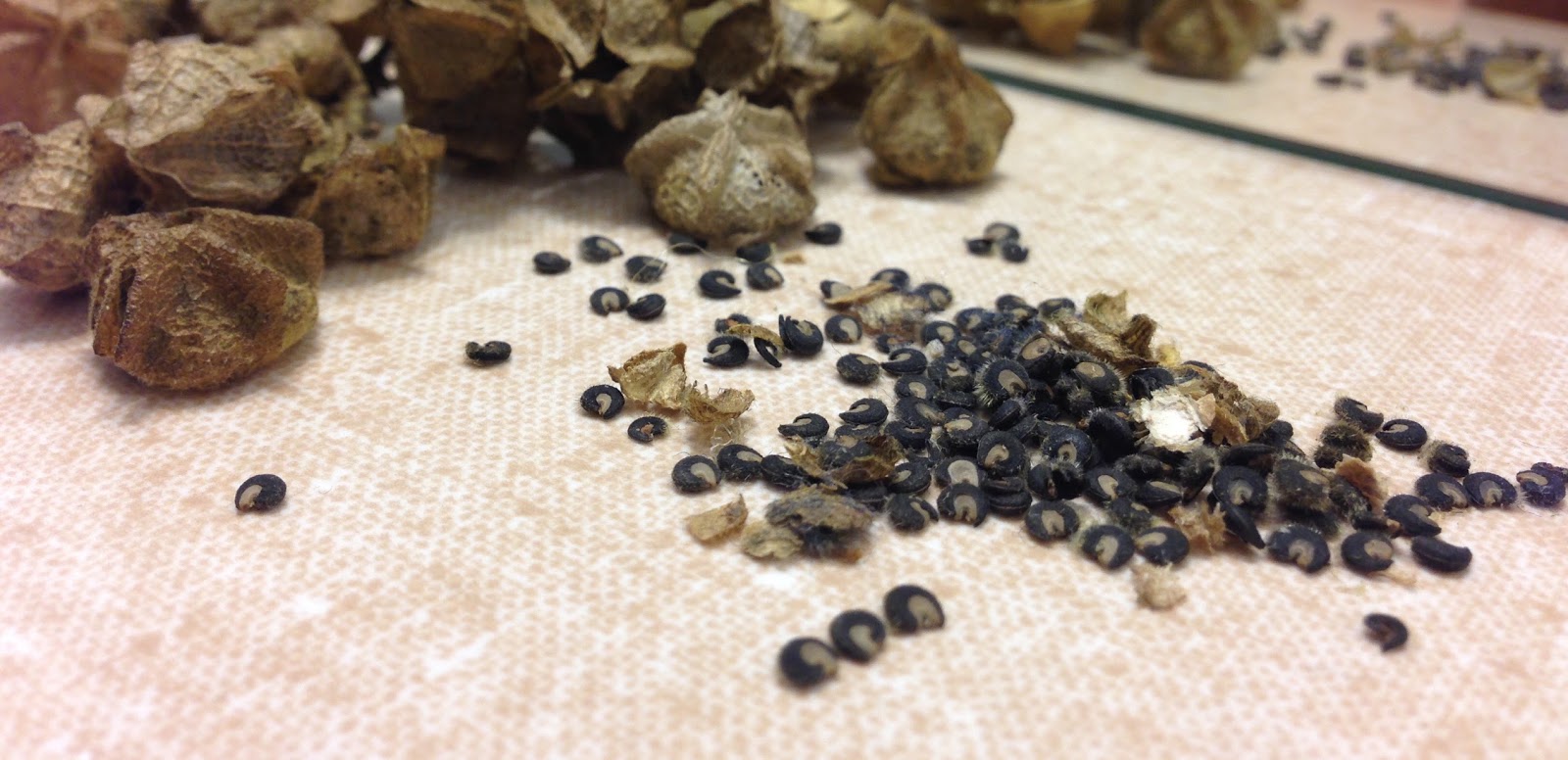
When the phlox flowers died back they revealed dried out seed pods, and when I picked one and tipped it upside down 15 tiny seeds tumbled out. I did a quick google search and found that propagating from seed is not recommended for phlox as the seedling will likely revert to its more wild form- the colour would not be the same as the mother plant. As it happens, that is not important to me in this case! If the bees still love it, the wilder, the better! I folded a sheet of paper that was destined for recycling, taped the edges shut, went back outside and shook each group of seed pods so their seeds rained down into the recycled paper envelop. 

Amazing that a single root would have cost $15 and now I have what must be at least 100,000 seeds! 


Now I am addicted. I love all the lilies in my mom's garden so I have been collecting those seeds too- I might even make little Christmas gifts with them! 

I was up North this week and saw a beautiful flower growing out of the crack in a sidewalk. It happened to have some dried seed pods on one branch. I did some seed sorting in my motel room! 

As I walked past a mature asparagus stand, well, I snagged some ripe berries from a female plant to see if I can propagate some from seed.

When I told my best friend about my new found hobby of stealing the genetic offspring of flowers she told me her mother is way ahead of me. Apparently she would go as far as carrying pruning shears and a small hand saw with her when they visited friends' homes. If she saw a plant she wanted she didn't just take seeds that have genetic variation- she took a genetic copy!

I hope I inspire you to look in the flower beds of your neighbourhood and embrace the possibility that it doesn't take any money to garden. In fact, you don't even need your own yard. Take some seeds from one place and guerrilla garden some forgotten corner of your neighbourhood. If you can harvest 10,000 seeds from one plant, even just broadcasting them over depleted soil  runs the chance that one of those unique seeds has the genetic make-up to grow, survive, and breed on that bit of ground. And you have taken a small action toward beautifying and re-naturalising an unloved space.

Have a lovely day
A small weekly harvest from the day neutral strawberries