Showing posts with label bees. Show all posts

Sunday, October 8, 2017

Gardening for Butterflies

After my last post I received an excellent question: apart from leaving milkweed in my garden, "How else can we encourage the monarchs?"

Milkweed is known to be critical for monarchs as it is the only  plant upon which monarch caterpillars can feed. The adult monarch butterfly however, can feed on any nectar producing flowers. If you want to give them a nutritious pit stop, plant flowers in groups. This allows butterflies to hop from one flower to another using relatively little energy while getting a full meal. 

Here are five great flowers for attracting butterflies.

Coneflower

Purple Coneflower


Aster
Aster


Black Eyed Susan

Black Eyed Susan


Bee Balm

Bee Balm


Lupine

Lupines


This is a beginner's guide as the truth is any flower/plant is useful as a habitat or source of food for an insect. Clumps of grass are great shelter during rough weather, for example. There are flowering charts and extensive lists of flowers and plants that attract butterflies for those who want to be meticulous.  If you aren't interested in having a binder of study material rest assured that having a diversity of plant species is guaranteed to attract winged visitors. Hummingbirds will certainly be attracted by the red flowers of your bee balm.  The only way to go wrong when planning a butterfly garden would be to create a lawn or to use pesticides. 

Biodiversity is the best thing you can offer. Try having perennial flowers that will flower at different times during the season, so that there is always a nectar source. Indigenous weeds are awesome when your gardening budget is low, letting them grow to flower before pulling them up is a great way to create a mini habitat with a huge amount of biodiversity. Indeed, these plant might be host plants for caterpillars from other species of butterflies.

Simply put: have a garden! Your garden is a space you are sharing with wildlife and insects. It is a refuge for these species from the acres of conventional fields and from the pavement and buildings that cover our cities and suburbs. 

Lastly, do them one huge (obvious) favour; don’t cover the plants and soil with pesticides and herbicides. The land might be in your name, but the earth cannot belong to a person. Animals and insects constantly have their food poisoned for something as superficial as a 'perfect' rose bush.

Go forth and make Eden rise! Really, it is that easy.

Tuesday, October 11, 2016

Seven

Fall is a time to take stock. I tried a few things this year and learned a few lessons that will allow me to move forward into more focused plantings.

1.     Asparagus loves my site/soil/climate. Now I am trying to decide how much more to plant next year,  whether I should invest in roots or start plants from seed, and how to prepare the soil in advance for a massive planting.
Asparagus in July. Next spring it will be possible to harvest two spears per plant.
Dwarf cherry, the leaves slowly died
 back until there was only this little
 tuft left. It lives, for now.
2.       Cherries and miniature kiwis are not suited to my site. While the plants still cling to life, the amount of trouble they are having surviving does not bode well. In the spring I will replant these plants in a different area and plant more worthwhile plants in their place. There is no point leaving the prime top-of-the-hill real estate to a group of plants that won’t bear fruit. Better to fill the space with fruit trees that have been doing well.
3.       Plums and apricots are fantastic. More of these will be planted. I love them- they are tough and not many local producers have these crops which means should I ever take them to the farmer’s market I won’t have competition.
4.       Strawberries are delicious, and I am still harvesting in October. There are a lot of strawberry producers in the area, though, so I will keep my production for personal consumption only.
5.       Praying mantises live in Canada! They, along with snakes, love my bit of land and I expect this has to do with leaving tall grasses. I will keep the areas directly below my trees tidy in the future, but will leave wild areas for biodiversity. This will also help wild pollinator species as I want to introduce more species of flowers to those areas.
This red currant produced
DELICIOUS and sweet berries!
6.       Some red currant varieties are delicious and sweet. They bear fruit the second year. I will plant more. Saskatoons taste good and bear the first year, but the skin breaks upon picking. This destroys their potential for even short term storage.
7.       Since the field has no irrigation, there is no point in preparing a vegetable garden with non-drought tolerant crops. Most of my vegetables did not grow. 

I love my project. I love that I can make mistakes and learn and always keep dreaming of potential futures the project could have. I was afraid of taking this risk, but it is the most worthwhile risk I have ever taken.

Have a lovely week.

Apricots have beautiful red tinted foliage all summer long.
Munching on grape leaves, this is one fat caterpillar.


Tuesday, September 6, 2016

Better when it's free

Varieties are important. Apples are a famous example that just because what you planted was a McIntosh seed, doesn't necessarily mean a McIntosh apple tree will grow. In fact, apple seeds are so variable you could plant ten seeds from the same apple tree and get different colours, flavours, and textures from each of the offspring.

Genetics are important in this respect. I do not want to spend time and money caring for a plum tree whose yields might be poor, disease prone, or bitter. I pay a premium to make sure that the genetic stock I have purchased will really be the legendary plumcot and not a random mutation.

However, there are times when genetics are less important. There are some flower species I have been keeping my eye on because they are very attractive for bees, butterflies, hummingbirds, etc. I do not want to grow them for profit, rather I want to grow them because I think Eden's Rise should be about more than pure food production (see previous post), it should also improve the condition of the soil it is on and provide refuge for wildlife displaced by the constant expansion of lawns and car parks. 

Some of the flower species I was looking into buying were already growing in my mother's garden. I noticed from their growth pattern that they propagated underground, a root from the mother plant travelled beneath the surface of the earth and pushed out a fresh plant a few inches away. I asked my mother if in the fall I could dig up some of the baby plants to transplant them in my garden and she happily agreed- some of these plants spread aggressively and need thinning out anyway. A single root from these plants cost $15 in Vesey's catalogue. 


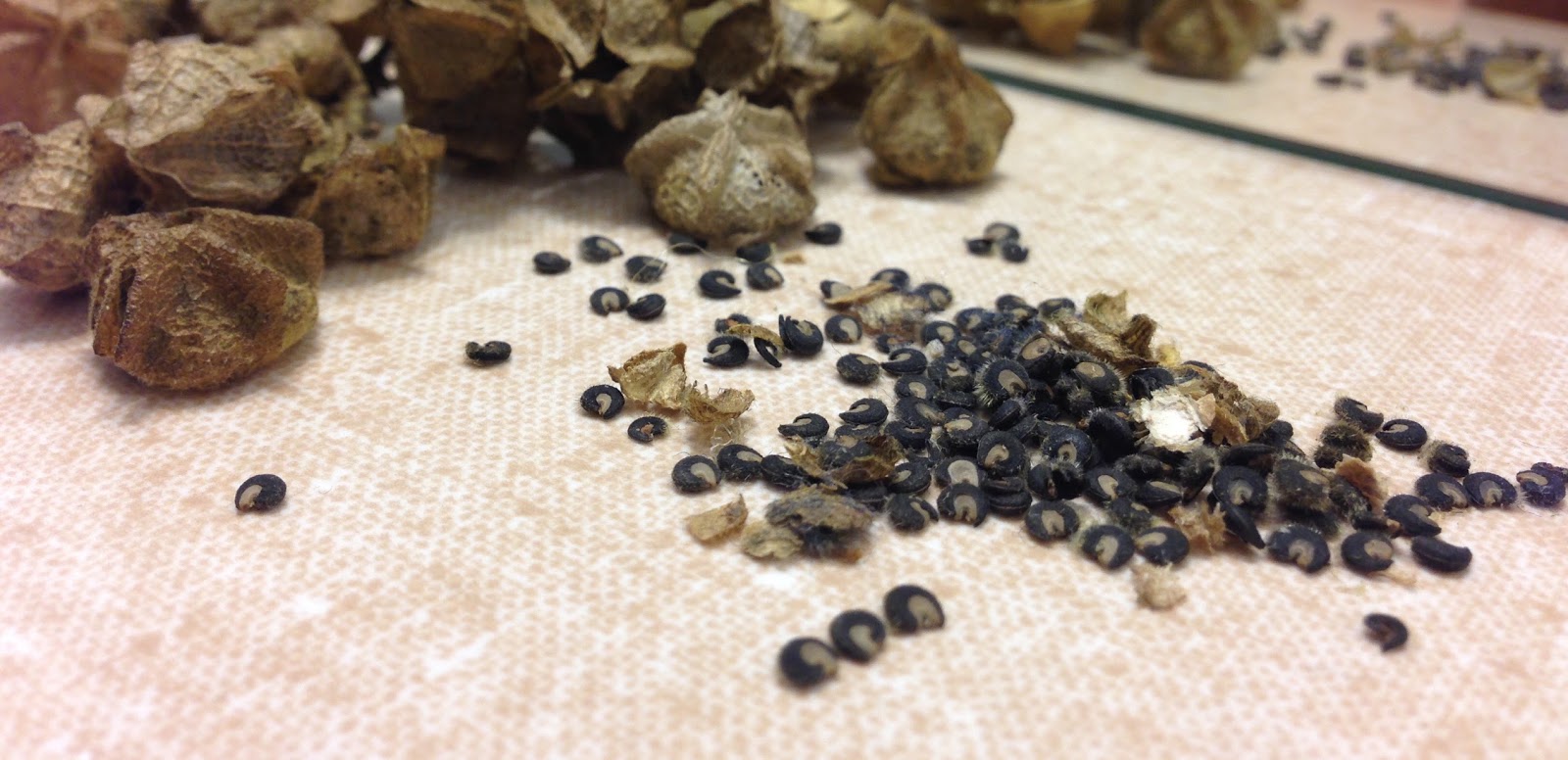
When the phlox flowers died back they revealed dried out seed pods, and when I picked one and tipped it upside down 15 tiny seeds tumbled out. I did a quick google search and found that propagating from seed is not recommended for phlox as the seedling will likely revert to its more wild form- the colour would not be the same as the mother plant. As it happens, that is not important to me in this case! If the bees still love it, the wilder, the better! I folded a sheet of paper that was destined for recycling, taped the edges shut, went back outside and shook each group of seed pods so their seeds rained down into the recycled paper envelop. 

Amazing that a single root would have cost $15 and now I have what must be at least 100,000 seeds! 


Now I am addicted. I love all the lilies in my mom's garden so I have been collecting those seeds too- I might even make little Christmas gifts with them! 

I was up North this week and saw a beautiful flower growing out of the crack in a sidewalk. It happened to have some dried seed pods on one branch. I did some seed sorting in my motel room! 

As I walked past a mature asparagus stand, well, I snagged some ripe berries from a female plant to see if I can propagate some from seed.

When I told my best friend about my new found hobby of stealing the genetic offspring of flowers she told me her mother is way ahead of me. Apparently she would go as far as carrying pruning shears and a small hand saw with her when they visited friends' homes. If she saw a plant she wanted she didn't just take seeds that have genetic variation- she took a genetic copy!

I hope I inspire you to look in the flower beds of your neighbourhood and embrace the possibility that it doesn't take any money to garden. In fact, you don't even need your own yard. Take some seeds from one place and guerrilla garden some forgotten corner of your neighbourhood. If you can harvest 10,000 seeds from one plant, even just broadcasting them over depleted soil  runs the chance that one of those unique seeds has the genetic make-up to grow, survive, and breed on that bit of ground. And you have taken a small action toward beautifying and re-naturalising an unloved space.

Have a lovely day
A small weekly harvest from the day neutral strawberries