Showing posts with label biodiversity. Show all posts

Thursday, October 4, 2018

Eden Indoors- Winter is Coming


I chose to name my business Eden's Rise, not so much as a name but as an objective. The literal Rise or Return of the Garden of Eden. As the weather cools and as vegetable ripening slows to a crawl, the season for market gardening draws to a close. I've been wondering about ways of continuing my mission ("Sell diverse products which remind customers of the importance of biodiversity and increase their environmental awareness.") throughout the winter.

During the season I was surprised at the popularity of plants. In the spring I sold quite a few perennials for the garden, then increasingly through the summer and early fall I've found Cacti, Aloe Vera and other miscellaneous houseplants that I've brought have sold reasonably well.


Which brings me to how Eden's Rise will continue to spread it's message this winter; I have signed up to attend two winter markets! Since making this decision, I've been visiting garden centers trying to find parent stock from which to propagate my plants. After all, one  mother Aloe Vera plant generated at least $70 in sales during the 3 months I have been bringing her offspring to market. I just needed more parents!


In addition to selling succulents and vines, I am waiting to receive seeds for several popular kitchen herbs, such as basil, cilantro, rosemary, and thyme, to grow for sale at the winter markets. Just because it is winter doesn't mean we shouldn't have fresh green stuff in our food!


I aim for zero waste in my life (imperfectly, but it doesn't mean you shouldn't try), and as Eden's Rise is clearly an extension of me, I also aim for zero waste in my business. All the pots used in production are enjoying a second life. They have all been donated to me from people in my village who kindly answered the call when I put a sign in the post office and by my front door asking for plant pots. With the second winter market being in mid-December, I worry it could be very cold so I have emailed the members of my garden club to save their empty bread bags for me and several have responded promising to do so. Reusing, reducing, this is how I want to do business.

Now please enjoy these photos of my plants. I hope they calm you in the rainy, windy days to come. If you see anything you like, send me a message and we can arrange a visit. Small pots are $5 each, large pots are $10, medium pots are $8.

Mini Cactus $5/each
Small succulents $5/each
Large Palm $10

Purple Heart $10 (without pot)
Wandering Jew/ Inch Plant $10

Sunday, October 8, 2017

Gardening for Butterflies

After my last post I received an excellent question: apart from leaving milkweed in my garden, "How else can we encourage the monarchs?"

Milkweed is known to be critical for monarchs as it is the only  plant upon which monarch caterpillars can feed. The adult monarch butterfly however, can feed on any nectar producing flowers. If you want to give them a nutritious pit stop, plant flowers in groups. This allows butterflies to hop from one flower to another using relatively little energy while getting a full meal. 

Here are five great flowers for attracting butterflies.

Coneflower

Purple Coneflower


Aster
Aster


Black Eyed Susan

Black Eyed Susan


Bee Balm

Bee Balm


Lupine

Lupines


This is a beginner's guide as the truth is any flower/plant is useful as a habitat or source of food for an insect. Clumps of grass are great shelter during rough weather, for example. There are flowering charts and extensive lists of flowers and plants that attract butterflies for those who want to be meticulous.  If you aren't interested in having a binder of study material rest assured that having a diversity of plant species is guaranteed to attract winged visitors. Hummingbirds will certainly be attracted by the red flowers of your bee balm.  The only way to go wrong when planning a butterfly garden would be to create a lawn or to use pesticides. 

Biodiversity is the best thing you can offer. Try having perennial flowers that will flower at different times during the season, so that there is always a nectar source. Indigenous weeds are awesome when your gardening budget is low, letting them grow to flower before pulling them up is a great way to create a mini habitat with a huge amount of biodiversity. Indeed, these plant might be host plants for caterpillars from other species of butterflies.

Simply put: have a garden! Your garden is a space you are sharing with wildlife and insects. It is a refuge for these species from the acres of conventional fields and from the pavement and buildings that cover our cities and suburbs. 

Lastly, do them one huge (obvious) favour; don’t cover the plants and soil with pesticides and herbicides. The land might be in your name, but the earth cannot belong to a person. Animals and insects constantly have their food poisoned for something as superficial as a 'perfect' rose bush.

Go forth and make Eden rise! Really, it is that easy.

Sunday, August 13, 2017

A Better Life

When I visited the village of Barauli, Nepal in April I fell in love with the place. The houses were small, on half acre lots where the land was perfectly levelled and filled using a system of ditches connected to the river ankle deep with water. Rice was growing in perfect rows and women hand weeding the fields, barefoot. 

Through the streets there were women walking their small herds of goats, or water buffalo. Many of them wear dresses in vibrant colours- clothes I would never dream of wearing for farm work for fear of getting them dirty! Around the houses there were chicks, chickens, and ducks. I walked all of the streets of that village on my own, everyone said hello as I walked past, and I felt safe and at home and more than anything I wanted to live there.

When I visited a city less than an hour from my home two weeks ago (Perth, Ontario) I was surprised to find it equally appealing, with flowers exploding out of every possible nook and cranny, the main streets are full of stores, pubs, and cafes run and owned by local people. The farmers market had live music and lots of interesting vendors. I wanted to move there too!

The problem with this thinking is that it doesn't allow me to fully appreciate my role in the community where I currently live. If I want my community to become like Perth or Barauli, I have to be part of that change. I have to stop looking with jealousy at what another has and put that energy into turning what I do have into something that is worth appreciating. 

My village has that look of a place which might have at one time been bustling with a lively centre but which has since been slowly dying. The symptom of nearby box stores offering people lower prices along with lower quality of life. 

If I want to live in a place vibrant and alive like Perth or Barauli (without moving there), I need to be the change I want to see in my community. I can make my front yard explode with colour and plant life. I can create a garden that can feed me, and share the excess with my neighbours. I can say hello to everyone I walk past. I can go to the art studio across the street that hosts live music on Sunday mornings to show there is a demand in this little village for affordable entertainment. I can give up the uncomfortably tight waistband of jeans and wear my beautiful dresses that I usually save for 'special' occasions that never come. 

This theme of making our place on earth more beautiful was a big part of my choosing to start Eden's Rise. I chose the name "Eden's Rise" for my orchard because I like that it invokes the idea that this orchard is where the Garden of Eden begins to reclaim the earth. 

I want to invite everyone to take their own journey and remember what is really important to them. Quiet the voice of culture and listen the child that lives within you. The version of you that survives societal pressures to conform. When you think of where in the world you would prefer to be - or what in the world you would prefer to be doing - I want you to really acknowledge those thoughts. Don't push them aside. There's no thought too big to be worth exploring. 

I have started with very small ways I can make my world better today, but I dream of living in a world where women are not still sold into sex slavery, a world where there are no borders preventing people from living in areas where they can find better work, a world where everything doesn't need to be wrapped in plastic, a world where we place more importance on preserving biodiversity than on making profits, a world where we care more about the health of people than profits.

We cannot do the work of improving this world if we don't first imagine what a perfect world looks like. Once we admit there is a problem with the current state of things we can begin to find a solution. Perhaps together we can make our world even just a little more like the Eden of which we dream.


Tuesday, May 30, 2017

Wet Noodles in the Garden

Weeding my asparagus patch this weekend was a joy. Weed a foot, celebrate with a spear, weed another foot, munch some more. Have you ever had asparagus fresh from the ground; raw, crunchy, juicy, and sweet? It was a discovery for me that asparagus could be so delicious. It was more reminiscent of fresh ‘mange-tout’ sweet peas than it was of the steamed spears traditionally laid out sparingly and artistically next to a fancy piece of animal flesh. I ate a dozen out there in the field, slowly burning the skin on the back of my neck.

Once these weeds are out of the way, this asparagus spear is my reward!
As I pulled the weeds up through the mulch I was surprised at the number of earthworms at work in there. When I was digging the holes for my new plants this spring I saw very few earthworms, yet here beneath an inch of grass they were having a huge party on the surface of the earth.

Everyone knows worms are meant to be a sign of a healthy soil. I wanted to take a moment of your time to talk about what it is these fleshy noodles actually do.

Worms live in the ground, of course. Like rodents, they like to keep a door to the outside world in their domicile. From this hole they reach out and grab at decaying organic matter. You can see evidence of this in fields where debris is left in the fall. It looks like many consecutive circles, each circle being the territory around a worm’s hole.
They eat this organic matter and defecate in their hole, deeper in the soil. This way nutrients are spread throughout the soil profile. This organic matter, now worm casts, contains nutrients that are more easily available to the plants thanks to Mr. Worm’s digestion.

The tunnels created by the worms also have positive effects. They aerate the soil, and create conditions for better drainage and water infiltration.  The channels also provide an easy avenue in which plant roots can travel deeper in the soil to find further sources of water. Even their wee, noble bodies decompose and provide nitrogen for the plants. A healthy population of earthworms can actually build topsoil, by how much seems to vary from one study to another. This is excellent news for me on my site, where the topsoil is a mere foot before reaching pure bedrock.

I will end on a darker note. The earthworm is not native to Canada. It appears its presence

is having a drastic impact on the ecology of our old growth forests. National parks advise people to avoid dumping left over earthworms from fishing trips in the forest. Take them home, feed them to your dog, just don’t empty that container (even if it is just dirt, they might have laid eggs in there!) in our forests.
Flowering Chum!


Have a lovely week, I wish you good health and happiness!

Tuesday, October 11, 2016

Seven

Fall is a time to take stock. I tried a few things this year and learned a few lessons that will allow me to move forward into more focused plantings.

1.     Asparagus loves my site/soil/climate. Now I am trying to decide how much more to plant next year,  whether I should invest in roots or start plants from seed, and how to prepare the soil in advance for a massive planting.
Asparagus in July. Next spring it will be possible to harvest two spears per plant.
Dwarf cherry, the leaves slowly died
 back until there was only this little
 tuft left. It lives, for now.
2.       Cherries and miniature kiwis are not suited to my site. While the plants still cling to life, the amount of trouble they are having surviving does not bode well. In the spring I will replant these plants in a different area and plant more worthwhile plants in their place. There is no point leaving the prime top-of-the-hill real estate to a group of plants that won’t bear fruit. Better to fill the space with fruit trees that have been doing well.
3.       Plums and apricots are fantastic. More of these will be planted. I love them- they are tough and not many local producers have these crops which means should I ever take them to the farmer’s market I won’t have competition.
4.       Strawberries are delicious, and I am still harvesting in October. There are a lot of strawberry producers in the area, though, so I will keep my production for personal consumption only.
5.       Praying mantises live in Canada! They, along with snakes, love my bit of land and I expect this has to do with leaving tall grasses. I will keep the areas directly below my trees tidy in the future, but will leave wild areas for biodiversity. This will also help wild pollinator species as I want to introduce more species of flowers to those areas.
This red currant produced
DELICIOUS and sweet berries!
6.       Some red currant varieties are delicious and sweet. They bear fruit the second year. I will plant more. Saskatoons taste good and bear the first year, but the skin breaks upon picking. This destroys their potential for even short term storage.
7.       Since the field has no irrigation, there is no point in preparing a vegetable garden with non-drought tolerant crops. Most of my vegetables did not grow. 

I love my project. I love that I can make mistakes and learn and always keep dreaming of potential futures the project could have. I was afraid of taking this risk, but it is the most worthwhile risk I have ever taken.

Have a lovely week.

Apricots have beautiful red tinted foliage all summer long.
Munching on grape leaves, this is one fat caterpillar.


Tuesday, September 6, 2016

Better when it's free

Varieties are important. Apples are a famous example that just because what you planted was a McIntosh seed, doesn't necessarily mean a McIntosh apple tree will grow. In fact, apple seeds are so variable you could plant ten seeds from the same apple tree and get different colours, flavours, and textures from each of the offspring.

Genetics are important in this respect. I do not want to spend time and money caring for a plum tree whose yields might be poor, disease prone, or bitter. I pay a premium to make sure that the genetic stock I have purchased will really be the legendary plumcot and not a random mutation.

However, there are times when genetics are less important. There are some flower species I have been keeping my eye on because they are very attractive for bees, butterflies, hummingbirds, etc. I do not want to grow them for profit, rather I want to grow them because I think Eden's Rise should be about more than pure food production (see previous post), it should also improve the condition of the soil it is on and provide refuge for wildlife displaced by the constant expansion of lawns and car parks. 

Some of the flower species I was looking into buying were already growing in my mother's garden. I noticed from their growth pattern that they propagated underground, a root from the mother plant travelled beneath the surface of the earth and pushed out a fresh plant a few inches away. I asked my mother if in the fall I could dig up some of the baby plants to transplant them in my garden and she happily agreed- some of these plants spread aggressively and need thinning out anyway. A single root from these plants cost $15 in Vesey's catalogue. 


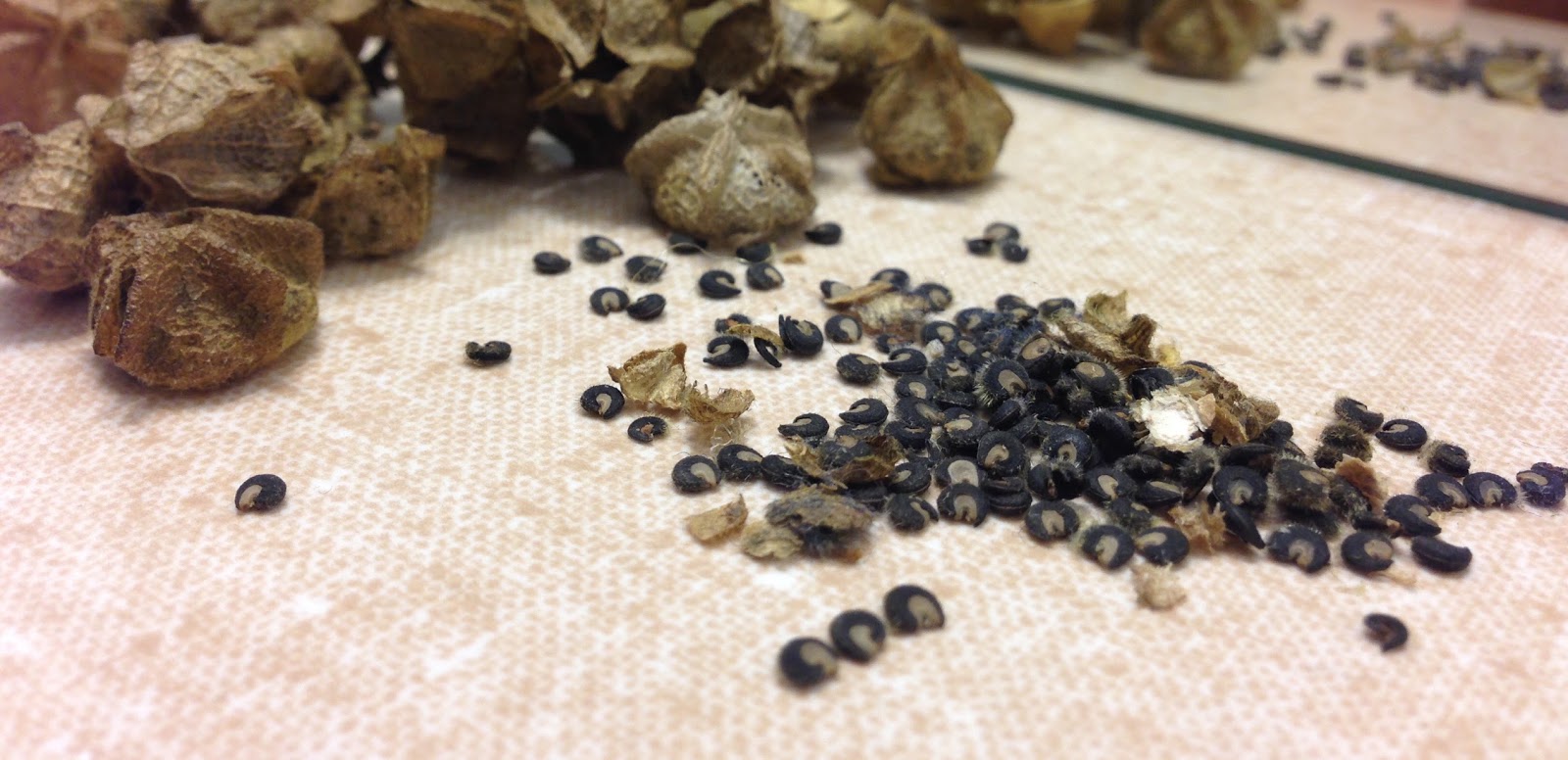
When the phlox flowers died back they revealed dried out seed pods, and when I picked one and tipped it upside down 15 tiny seeds tumbled out. I did a quick google search and found that propagating from seed is not recommended for phlox as the seedling will likely revert to its more wild form- the colour would not be the same as the mother plant. As it happens, that is not important to me in this case! If the bees still love it, the wilder, the better! I folded a sheet of paper that was destined for recycling, taped the edges shut, went back outside and shook each group of seed pods so their seeds rained down into the recycled paper envelop. 

Amazing that a single root would have cost $15 and now I have what must be at least 100,000 seeds! 


Now I am addicted. I love all the lilies in my mom's garden so I have been collecting those seeds too- I might even make little Christmas gifts with them! 

I was up North this week and saw a beautiful flower growing out of the crack in a sidewalk. It happened to have some dried seed pods on one branch. I did some seed sorting in my motel room! 

As I walked past a mature asparagus stand, well, I snagged some ripe berries from a female plant to see if I can propagate some from seed.

When I told my best friend about my new found hobby of stealing the genetic offspring of flowers she told me her mother is way ahead of me. Apparently she would go as far as carrying pruning shears and a small hand saw with her when they visited friends' homes. If she saw a plant she wanted she didn't just take seeds that have genetic variation- she took a genetic copy!

I hope I inspire you to look in the flower beds of your neighbourhood and embrace the possibility that it doesn't take any money to garden. In fact, you don't even need your own yard. Take some seeds from one place and guerrilla garden some forgotten corner of your neighbourhood. If you can harvest 10,000 seeds from one plant, even just broadcasting them over depleted soil  runs the chance that one of those unique seeds has the genetic make-up to grow, survive, and breed on that bit of ground. And you have taken a small action toward beautifying and re-naturalising an unloved space.

Have a lovely day
A small weekly harvest from the day neutral strawberries

Sunday, August 14, 2016

Welcome Mantis, bring your friends

I kept my word and have been watering my plants every evening, when possible. I had to miss a night here and there due to either social events or back pain, but overall my plants have been spoiled these past two weeks and they love it!

I see lots of new wood, new leaves, and the largest surprise of all- a few days after I started regular watering, the insects that were eating the leaves nearly all disappeared. One exception is one apple tree was attacked by several hundred miniature caterpillars, but after a bit of squishing they seem to have disappeared too.

Best of all- it finally rained yesterday. A welcome relief during our summer or drought.

There haven't been many pictures lately of Eden's Rise and that is because of how brown, crispy, and dead the field looks. The only colour comes from my trees and the particularly drought resistant golden rod that has taken possession of the bottom of the field. 

And yet life carries on. I don't know anything about snake life cycles but there are some miniature snakes hanging out near my asparagus and I assume they must be some recent hatchlings. I love snakes, and I am happy that having left the grass long means that they feel comfortable having a habitat in my garden. 

There are also voles, or some kind of fluffy round ball animals. They make holes and run away in a flash of dark fur when I approach them. They don't seem particularly destructive, but I don't appreciate when they make their holes right through the roots of my newly planted trees. They likely don't appreciate me planting trees right through their newly dug holes.

Today I made a new friend: a praying mantis! 


At first I was horrified, all my knowledge about praying mantises came from an episode of Buffy the Vampire Slayer where Xander was nearly eaten by a large Praying Mantis Demon Lady. Still, I had an idea that it was probably not eating my plants and likely even a welcome visitor for my garden. A quick google search when I got home confirmed it. It seems they have enormous appetites for aphids, mosquitoes, caterpillars, and a bunch of other bugs I have no immediate love for. Suddenly I love my new freaky insect friend, and I hope she invites all her friends over for a party! 

Have a lovely week, and take some time to look at nursery catalogues. If you want to start your own orchard or want to plant flower bulbs, then fall is a great time to plant.