Showing posts with label trees. Show all posts

Sunday, June 25, 2017

Why Does my Tree Only Bear Fruit Every Other Year?

Last summer someone wondered aloud to me that there were not many wild flowers. This year, walking through the forest and wild meadow on the way to the orchard flowers are exploding from the ground, trumpeting life and the air buzzes with insects. I knew that 2016’s drought was a heavy one for our area, but the stark contrast with 2017’s wet spring is shocking.

My fruit trees are growing like fireworks, currant bushes I planted as twigs in May have quadrupled in size. The blueberries I planted this spring have already outgrown the ones that struggled to survive the dry summer. The grass last July was brown and flattened against the earth, now it makes a solid green curtain reaching my navel. It has turned the orchard into a maze where I have to guess the general direction of my Honeyberries to find them. The grass is taller than most of my berry bushes, but they don’t seem to mind. They all have a small radius where I have weeded and mulched the 'root zone'. After all the rain we’ve been having and my application of manure last week the orchard is singing. A monarch butterfly flutters past, floating above the tall grasses and flowering milkweed.

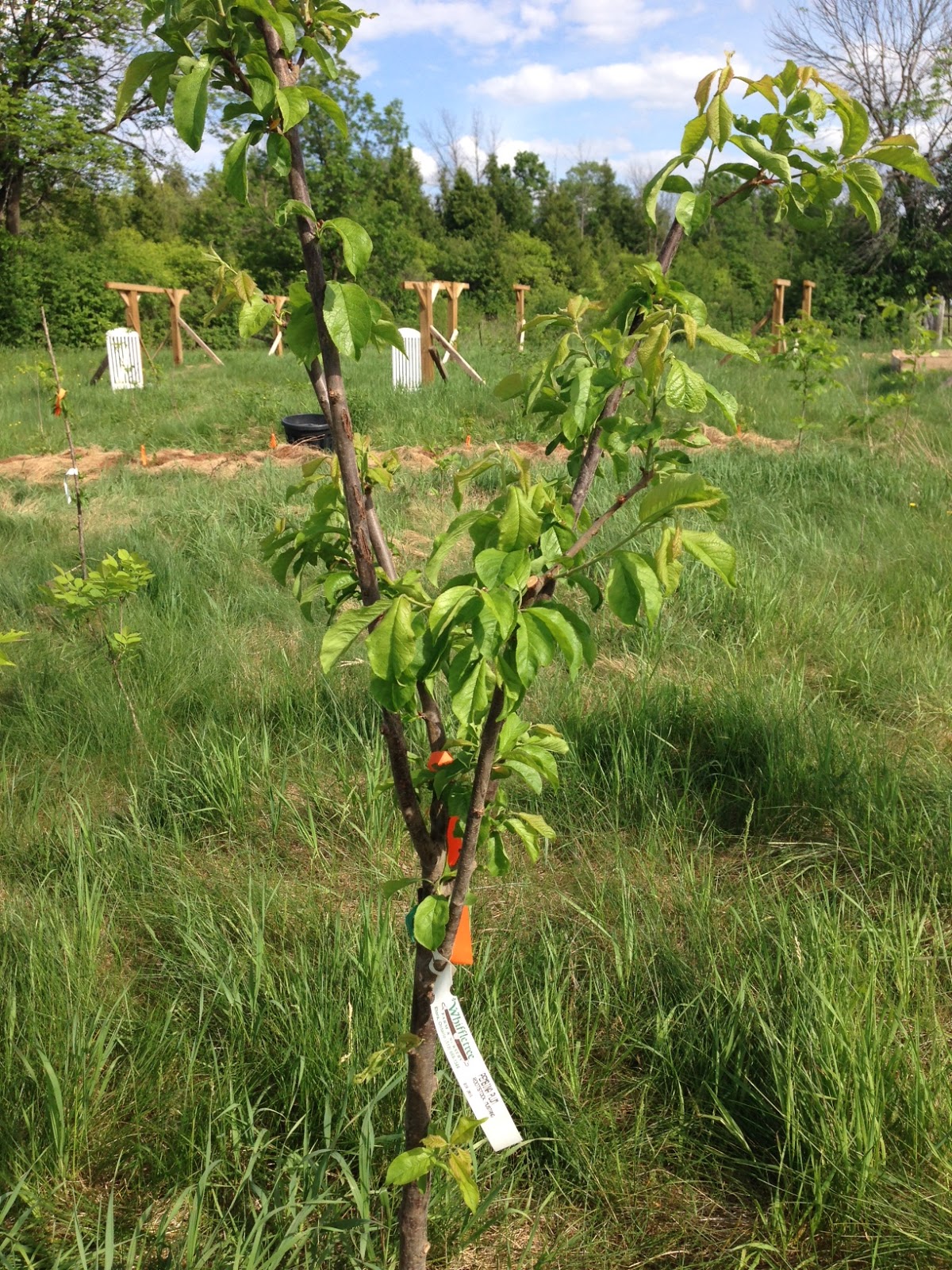
This week I’d like to address a question sent by a reader asking why their apple tree did not flower this year. I commonly get asked about this sort of fruit tree behaviour. The alternate version of the same question is: Why does my fruit tree only bear fruit every other year?

Trees run on a two year cycle when it comes to flowering. Trees want to produce fruit and seeds in order to create offspring. Imagine this year your tree is not producing any fruit. It is going to put a lot of energy into creating flower buds which will be able to produce fruit next year. Fast forward to next year, the tree is loaded with pollinated flowers and it is using all of its energy to ripen its immense load of fruit. This means that during this second year the tree has not been able to invest energy into next year’s flower buds. Year three we are back to a tree with no fruit.

In commercial orchards farmers control the fruit set by spraying the trees (in both conventional and organic agriculture this is a permitted practice, though the chemicals and techniques differ) in order to make them drop two thirds of the potential fruit load. This means the apples, or peaches, or plums that are left on the tree will ripen bigger and more flavourful.  At the home scale you can thin fruit by hand and ladder. My second year working in agriculture I spent a few days in spring thinning fruitlets on peach trees in a greenhouse in northern Ontario.  It is a slow process, but it improves fruit quality and ensures a harvest for next year.

Once trees have gotten used to biennial bearing, it is very difficult to restore them to annual bearing. As far as I am aware it is not impossible, but the ease at which you can bring those trees back is largely affected by how long they have been allowed to bear fruit in this way.

Your berries won't need thinning, they are pretty good at self-regulating. You should thin your grapes to improve flavour. The amount of grapes you leave on depends on the vineyard, the use for the grapes (wine or fresh eating), and the climate. Go with your gut, trust your instinct. Often when it comes to plants the power of observation will lead you to the right place.

Hoping you enjoyed a lovely summer solstice, have a lovely week.

-E.V.

Thursday, August 25, 2016

The Farm vs. The Garden

What is a farm and what is a garden?

A farm should be profitable, first of all, and efficient. Straight rows, evenly spaced, soil tilled into a perfect seed bed in order to produce a uniform crop. Orchards are made up of trees in straight lines and the width between the rows reflects tractor size and manoeuvrability as much as it reflects plant requirements. Animals are fed a standard diet and more or less confined to a designated area. There is nothing growing on a farm that does not serve a purpose.

That, at least, is my impression of farms. I love them, and always have. I've worked on loads of farms and dearly wish I had found a nice farm lad to be my husband so that I could live and work on my own farm. 

Don't get the impression that I don't think I am capable of starting and running my own farm without a man involved. Of course I could, and if that's your dream (irregardless of gender or marital status) I encourage you to jump in. 

What is holding me back is that I do not like to limit myself to the analytical thinking required to make a farm efficient and profitable. When I'm at work I'm a huge fan of the "work smarter, not harder" approach, but when it comes to my dreams I want to create a place where food is plentiful, nature is welcome, and puttering is encouraged.

Eden's Rise is a productive garden. Fruit, flowers that are known to be good for wild bees, herbs, and some annual vegetables will all grow here. This year so far I've accomplished three of those four goals, though on a tiny scale. Next year Eden's Rise will be unrecognisable as the little fallow field it once was. 

This fall I am planting 155 more fruiting shrubs and ~200 mixed flower bulbs. In the spring will come ~40 more fruit trees, and possibly some nuts as well. Then, I have a plan for companion planting vegetables, flowers, and herbs below the fruit trees using the permaculture principles of plant guilds. I have begun digging swales and seeding the lower portion in clover to increase soil nitrogen and hopefully the deep roots will break up some of the bedrock. I also need to set about establishing some more permanent raised beds for vegetable and herb production. The raised bed designated for wild flowers will be reseeded again in the spring and hopefully next year a three month long drought will not once again kill all the newly sprouted plants. And all this while trying to plant in a way that is visually appealing. 

Eden's Rise aims to blur the lines between utility and beauty. 

What is a farm and what is a garden? Both are amazing proofs of humanity's ability to influence and change our landscapes and environment. But can a farm be productive and efficient while being beautiful? Can a garden be beautiful while still being efficient and productive? 

Have a lovely week.

Sunday, August 14, 2016

Welcome Mantis, bring your friends

I kept my word and have been watering my plants every evening, when possible. I had to miss a night here and there due to either social events or back pain, but overall my plants have been spoiled these past two weeks and they love it!

I see lots of new wood, new leaves, and the largest surprise of all- a few days after I started regular watering, the insects that were eating the leaves nearly all disappeared. One exception is one apple tree was attacked by several hundred miniature caterpillars, but after a bit of squishing they seem to have disappeared too.

Best of all- it finally rained yesterday. A welcome relief during our summer or drought.

There haven't been many pictures lately of Eden's Rise and that is because of how brown, crispy, and dead the field looks. The only colour comes from my trees and the particularly drought resistant golden rod that has taken possession of the bottom of the field. 

And yet life carries on. I don't know anything about snake life cycles but there are some miniature snakes hanging out near my asparagus and I assume they must be some recent hatchlings. I love snakes, and I am happy that having left the grass long means that they feel comfortable having a habitat in my garden. 

There are also voles, or some kind of fluffy round ball animals. They make holes and run away in a flash of dark fur when I approach them. They don't seem particularly destructive, but I don't appreciate when they make their holes right through the roots of my newly planted trees. They likely don't appreciate me planting trees right through their newly dug holes.

Today I made a new friend: a praying mantis! 


At first I was horrified, all my knowledge about praying mantises came from an episode of Buffy the Vampire Slayer where Xander was nearly eaten by a large Praying Mantis Demon Lady. Still, I had an idea that it was probably not eating my plants and likely even a welcome visitor for my garden. A quick google search when I got home confirmed it. It seems they have enormous appetites for aphids, mosquitoes, caterpillars, and a bunch of other bugs I have no immediate love for. Suddenly I love my new freaky insect friend, and I hope she invites all her friends over for a party! 

Have a lovely week, and take some time to look at nursery catalogues. If you want to start your own orchard or want to plant flower bulbs, then fall is a great time to plant. 


Saturday, July 30, 2016

Lessons

Things have been a bit bleak lately. My plums are being massacred by insects, my strawberries are being ripped up by neighbouring horses, my blueberries look like they're burning from the leaf edges, my grapes are stunted. 

It's all my fault.

I frequently visit other people's orchards. Usually they are an abandoned side project and I've been proud to see that for the most part my trees look like those in orchards that were planted several years ago. My bubble burst when I visited my best friends who planted their orchard at the same time as I planted mine. Their trees have at least twice as much new wood, three times more leaves, and no apparent evidence of insect damage. 

I hated them.

Only briefly. (C'mon, a little jealousy keeps you human!)

Their orchard is very near their house, which allows them to water it daily. They need to. Their soil is sandy and has trouble holding water. Daily water and the endless heat and sunshine that we've had this summer are the perfect recipe for plant growth. 

I've started a new job this summer and with the busy whirl of finding my feet in a job that has me travelling around the province I've been neglectful of my orchard. I've only been watering Eden's Rise once a week, sometimes even less. No wonder my trees are being ravaged by insects, curling their leaves up, turning yellow, and my two weakest plants (weak since being planted too early and getting a hard knock by the frost) have finally died. 

I realised that far from being on par with those older orchards, I was on the road to having my orchard stunted and looking much as it does now even 4 years from now when ideally I should be in full production. Tough love is not what these young trees need.

Like a procrastinator who has realised the deadline is now only 2 days away I've been pushed into action by panic. I have been watering my orchard every day for 4 days now. To see change overnight seemed too good to be true and yet change is here!

My elderberry plants have added an inch of new wood in 3 days, my plum which had lost 60% of its leaves to insect damaged has now sneezed out a huge tuft of new leaves which totally hides the half eaten massacre within. The blueberries with crusty leaf edges are pushing out some fresh green leaves and the grapes which have been lacking in action nearly all summer have finally sent enough tentacles to reach the first wire of my trellis (about 4 feet) (not all of them, some varieties seem to be struggling more than the rest). 

Seeing an immediate result to my extra work is exactly what I needed for morale. I should have known thirsty plants don't have the energy to fight off predators, etc.

Things will be back on track now at Eden's Rise. It may take 2 hours a night to water my orchard, but let's face it. What else would I be doing?

Have a lovely week!
-Eden

Sunday, July 3, 2016

Why Garden?

It's a lot of work; so why garden?

It would be easier not to plant all these trees. In the supermarket we can buy local fruit and exotic fruit of all shapes and colours. But they have about 1/4 of the taste and texture compared to eating them ripe off the tree. That's one reason people garden. Taste. 


This is pretty much the entire harvest for 2016, so why bother?
You could spend Sunday mornings laying in bed until noon while watching a Netflix show and eating Nutella straight from the jar (tempting) instead of working 6 hours lugging water, raking, weeding, digging, and generally 'working'. This physical exertion gives you strength, a well earned hunger, and energy that can only come from regular exercise. You might garden for your health.

When you shop for seeds, bulbs, plants; fruit, vegetable, or floral- you have so many options to choose from. You can plant huge flowers of all colours, try 20 varieties of tomato, grow something you've never heard of for the chance to try an unknown berry in several years' time. You can garden for variety and discovery.


If you read this blog, you're likely a gardener yourself. What's your reason for gardening? Have you ever even stopped to wonder why you do it?


My reason is pure and simple: I enjoy it. 

I dig and sweat in the sun on a cool morning. I hear the birds sing. I look up to see a herd of wild turkeys watching me, or a weasel carrying a rodent half its size. I hear the wind and the hum of bees and forget about time, people, stress, traffic, internet, deadlines. I reconnect to the true meaning of life, to nature. 

It isn't work to me, I wouldn't want to be doing anything else. 

You can leave your comments below, I would love to hear about your own adventures into gardening! 

Have a lovely week.

Saturday, June 25, 2016

Obsessed, mulch?

Strawberries plants are often mulched. Mulch keeps the berries clean (no direct contact with soil), it also acts as a temperature buffer and reduces moisture loss from the soil to the sun. Best of all for the farmer with a bad back; mulch suppresses weed growth!

Strawberry beds kept tidy with use of mulch

My little field has been fallow for at least seven years. That's seven years of grass growing and dying. Mulch can be expensive for the organic gardener, but for me it was only a matter of raking for 10 minutes to get enough old grass together to cover one bed. 40 minutes later all my strawberry beds were mulched!

Blueberries mulched with pine needles and grass
The result was so good (particularly on the weed side) that I figured I should do this for all the plants on Eden's rise! The blueberries have a mixed mulch of pine needles (to increase acidity) and grass. All trees, bushes, and vines have a small circle of coconut coir mulch from planting day that has now been covered by a larger circle of grass mulch. I am grateful that I began this little project after the first full week without rain. There has been very little rain so far this summer and the field is in the full sun all day when the temperature is frequently above 30 Celsius. The mulch keeps the weed competition away for the base of my plants so when I waddle over with water for each tree I know I am not wasting that water on weeds. Thanks to the layer of mulch the hot sun also loses much of its opportunity to steal the water and the soil does not bake. 

Those are the often praised advantages of mulch, but I enjoy mulch for another reason. Bare soil, as the soil would be if I managed to keep it weed free, is subject to erosion. Anyone who has ever had a passing interest in sustainable agriculture knows that loss of topsoil is a serious problem in areas that are routinely cultivated. Erosion from wind and rain can hit hard on fine soil particles (like my clay soil). Since the soil depth on my hill is only about 1.5 feet to bedrock, every bit of soil is precious. The mulch will eventually rot down and be incorporated into the topsoil with the positive effect that in this case agriculture adds to the topsoil rather than depleting it. 

Two rows of asparagus, mulched around the edges with plastic
 and mulched in between with grass

There is always work to be done on Eden's Rise, I will leave you at that! Have a lovely week.

The grass looking fairly well combed after a raking session to mulch the apple trees.


Sunday, June 12, 2016

Paradise or Junkyard- the fine line

I don’t know if there’s a word for people like me. People who hate to see things wasted. People who recycle, upcycle, shop in charity shops, garage sales, flea markets, and who start and participate in clothing exchanges. People who unashamedly stop to pick up stuff from a stranger’s garbage that’s been put out to the curb.

Cheap?

Environmentally conscious?

Thrifty?

The word hoarder definitely does not apply to me as I love giving things away as much as I love collecting them. It is the knowledge that something that was destined for the trash has been rescued and given another life with someone who can appreciate the item’s worth that makes me happy.

What people who aren’t addicted to re-using don’t realise, is that it is actually quite a lot of hard work. You may call me ‘cheap’ because I was not willing to go out and spend $200 on a new computer chair, but you could also call me ‘patient’ for instead making do until one in my neighbourhood was put out for the trash. You may call me a ‘garbage picker’ for rescuing the shitty chair covered in chalk and paint, but you could also call me a ‘hard worker’ for spending over two hours cleaning it until it was a beautiful black computer chair. And you could call me ‘clever’ for then selling that chair many months later when I had to move.

Old tyres aren't widely recycled, but at Eden's Rise
they can live a second life as flower containers.
The problem with using the word cheap is that I am willing to spend large chunks of money on things I love. But when it comes to material goods, I know how much stuff is circulating in my rich country and how likely it is that what I want is sitting in someone’s basement somewhere waiting to be given a second life. Re-painting an old beige dresser, rescuing picture frames, getting a whole new wardrobe from the unloved clothes of a friend, these bring me so much joy and pride.

Eden’s Rise is an extension of this drive inside me. Raised beds made from old pallets, a flower bed made from old tyres, a rain barrel purchased second hand online, trellises made from the sides of an old crib found on the side of the road, mulch that was once a growing medium in a local greenhouse, and plastic mulch made from the growing bags. None of this is easier than just purchasing things new. Most worryingly, it is a fine line between a successful re-use and having the orchard look like a trash pile.

Old pallets used to make raised
beds for strawberries
Even the dead grass on Eden's Rise
gets a second life as 'straw'
The field itself is a prime example. Unused and vacant, now I am trying to give this little acre new life. Among my own trees and gardens are tall grasses, self-seeded trees, and weeds weeds weeds. Why don’t I just chop them all down? Good question. Partly because native wildlife depends on the little environment in the field, partly because I think if I removed all those distractions the wildlife would target my trees (which are still little more than twigs), and partly because I don’t think it’s necessary yet. I am looking for a second hand mower to keep the middle path trimmed down, but otherwise I keep a large enough circle of mulch around my trees and weed this diligently so that at least there is not competition for the water and nutrients at the base of my trees. I’ve also cut back the self-seeded tress that were shading my plants.

Asparagus hates competition-
here old grow bags are being
used as plastic mulch.
To come: the whole asparagus
patch will be framed with
recycled pallets. 
Ugly, or original beauty? Again comes the patience aspect of being a person like me. You don’t expect what you want to fall in your lap the second you conceive it. You wait. Now it looks like a disaster zone, but little by little I will transform it into a gem.

I want my orchard to be a beautiful paradise, fruit trees and bushes with an under story of wildflowers. 

Though for now it does look a bit like a hoarder’s back garden.


 Have a lovely week!
Eden's Rise- weedy mess or young paradise? Here are the edges of the crib I found in front of a neighbour's house, now painted white and added to the top of Eden's Rise to give the illusion of open gates welcoming you in. Hopefully we'll have some Nasturtiums climbing up these someday soon. Also in the picture is the second hand rain barrel that's often used for emergency watering needs.


Sunday, June 5, 2016

Water on Eden's Rise

Let’s say you plant an orchard and then the rain doesn’t come. Your orchard does not have a well, and it is far from the main road. How do you cope?

The Eden’s Rise solution has been to carry water through the woods to the back acre slice that is the orchard. It’s not an elegant solution, but a working one until I can convince the sky to drop some water down into the field and find a way of collecting it.

We are expecting rain today, at last. All the plants are trembling with excitement (or is that the wind?). As you can probably see from the picture of my plum tree, the leaves are hanging a little low and look visibly dehydrated. Carrying water back in a large barrel is all right if you just want your trees to survive, but I am convinced had they had proper water this past month they would have grown twice as much. Every day I’ve been worryingly watching the forecast, rain kept disappearing further and further away. I know that I can’t hope to have my trees strong and healthy if I cannot deliver a proper soaking at least once a week. The weather for the past two weeks has been hot, dry, and sunny.


Today I am holding my breath until the rain comes, then I’m counting each drop of rain like a blessing. 

Sunday, May 22, 2016

The Flowering spring

Eden’s Rise has gone from a low-maintenance uncultivated bit of land to an orchard screaming for attention. A week and a half without rain, grass growing through the mulch, vegetable gardens need to be prepared, the last raised bed box needs to be built and the flowers…


When transplanting bare-rooted trees, many roots are lost in the process. These little trees have a compromised root system and very little wood in their trunk. To compensate for the loss of root, I trimmed back the branches at planting time, being sure to leave only 50% or less of the wood (technically it should be closer to 30% but it was my first time and it’s scary hacking away at $50 trees!). Now the roots are able to adsorb enough water to support their remaining limbs.

This first year is a dance for life, if the roots don’t develop well enough this year, it will mean regular watering next year and the year after… it is better to encourage root development now and then have peace of mind next year that if it doesn’t rain for a week and a half, I don’t have to run over to the field with buckets of water every three days to help them out. I also want them to be developing a healthy thick trunk that will help them survive harsh winter temperatures.

How to do this?

You can imagine I gave my young trees a severe talking to this week when I walked into the field to find a dozen of them flowering! I quickly picked off all flower buds and open flowers but I know when I return today I will have more flowers to remove. Deflowering at three weeks! They are far too young!

The wood from these trees was originally a branch on a mature tree. They were cut off and grafted to a rootstock (most of mine I chose a semi-dwarfing rootstock) and shipped to me after the graft was properly healed. We can talk more about grafting in another post, but for now it’s just important as the trunk still thinks it’s a branch in a much larger tree system (plants don’t think in the sense humans do, but bear with me here guys, it’s artistic license).

When the tree flowers and a bee visits to introduces male pollen to the female flower’s stigma (the open end of a tunnel that will draw pollen into the ovary) it takes a lot of energy from the plant. By the time a fruitlet is visible, half of the energy required to make a fully ripened fruit has already been expended. This year I cannot allow/afford for the trees to bear a single fruit as it could come at the cost of losing the tree in the winter.

Simple as that.

Next year some of the smaller bushes will be allowed to fruit, like the blueberries, saskatoons, and currants. The apples, plums, and cherries will have to wait until year 3 at the earliest.

You don’t plant an orchard if you’re in a hurry!


Have a lovely week.

Monday, May 9, 2016

Saskatoon Berry

It has been a week since planting day, and I have returned almost daily to see the progress of my plants. While most of the trees are still dormant, the cherries are tentatively opening some buds. The winners in the race are my smaller fruiting plants- the bushes. There are signs of life from most of them, and several varieties have already been brave enough to unfurl a few leaves!

The real stars of the show are the Saskatoon berries. They have grown so rapidly I can almost see them grow. From a bare stick a week ago, they have shown a tremendous desire to thrive and survive. (The three pictures along the left are of the same plant a few days apart.)

Never heard of a Saskatoon berry?

 I have never heard of it being grown as a commercial crop, and had you asked me a year ago what they looked like I would not have had a clue what to tell you. It is the description from the nursery catalogue that pressed me into ordering 8 of these plants—but really after waiting so many years to have a chance at growing my own orchard, I had trouble not trying one of everything in the book!

Saskatoons make a good hedgerow, which is why my 8 plants are lined up with the neighbour’s fence, though far enough away that his horses can’t reach over and eat them! The plant is native to the prairies which makes it extremely hardy (up to Zone 2!) and the catalogue promises that Saskatoons are the easiest berries to grow, they will accept any type of soil! Perfect! Of course, now if the Saskatoons fail I will know that the problem is not my soil—it’s me!

As for flavour, I am not sure that Saskatoons are very palatable if eaten raw, but I am told that birds love them and this can be a useful crop for luring birds away from fruit that has higher market value.


How long before we can taste the berries? Hopefully these plants should be well established enough by next year to allow pollination of some flowers. A nice relief to have some plants that will bear fruit early. It is a shocking investment planting an orchard and then having to wait 5 years with your fingers crossed for good weather and low pest pressure before harvesting a decent crop!

 The star of the week, the lovely Saskatoon berry!