My gooseberries are having a rough time. The leaves began to show small black spots, then eventually they dropped off the plants. As of now they are all still alive, a couple new leaves are growing on each plant, but I doubt they have had enough of a chance to strengthen themselves in order to survive a Canadian winter.
What is happening?
Black spots on the leaves are usually the sign of a fungus. This fungus comes from leaves that fell last year; the spores flew up to the new foliage in the spring. What annoys me is that this makes no sense; I planted all of these plants this spring before they had any foliage and there were no gooseberries in my field previously. There is no cure or remedial action to be taken. The recommendation is to plant gooseberry varieties which are resistant to this disease/fungus/mystery death. This means I spent $400 on plants that were doomed to die because of their genetics. Fantastic.
My currants are looking a bit yellow as we approach fall. I wonder if their feet are too wet, or if there is a lack of nitrogen in the soil. They have grown about 8 times the size that they were in the spring when I planted them, so they seemed happy enough until a couple weeks ago. I did add manure to the plants a month or so after they were planted. I wasn't overly generous as I worried applying manure when plants were so young could burn the immature root tips. In the fall and spring I will apply more generous amounts in order to increase the nutrients in the soil, and continue with regular applications of manure every year.
Yesterday the blueberries received their aluminum sulphate, which should work to reduce the soil pH. I also applied some peat moss below the bushes which increases soil organic matter and acidity too. I picked the last of the blueberries yesterday, as well as eating a couple plums and chums. I wasn't supposed to let them produce fruit until year 4 (this is year 2) but I wanted to sample the fruit to know which trees are worth ordering more of.
That's the update from the wee orchard!
Showing posts with label plum. Show all posts
Showing posts with label plum. Show all posts
Saturday, August 19, 2017

Tuesday, October 11, 2016
Seven
Fall is a
time to take stock. I tried a few things this year and learned a few lessons that will allow me to move forward into more focused plantings.
1. Asparagus loves my
site/soil/climate. Now I am trying to decide how much more to plant next
year, whether I should invest in roots
or start plants from seed, and how to prepare the soil in advance for a massive
planting.
 |
| Asparagus in July. Next spring it will be possible to harvest two spears per plant. |
 |
| Dwarf cherry, the leaves slowly died back until there was only this little tuft left. It lives, for now. |
3. Plums and apricots are fantastic.
More of these will be planted. I love them- they are tough and not many local
producers have these crops which means should I ever take them to the farmer’s
market I won’t have competition.
4. Strawberries are delicious, and I am
still harvesting in October. There are a lot of strawberry producers in the
area, though, so I will keep my production for personal consumption only.

 |
| This red currant produced DELICIOUS and sweet berries! |
7. Since the field has no irrigation,
there is no point in preparing a vegetable garden with non-drought tolerant
crops. Most of my vegetables did not grow.
I love my project. I love that I can make mistakes and learn and always keep dreaming of potential futures the project could have. I was afraid of taking this risk, but it is the most worthwhile risk I have ever taken.
Have a lovely week.
Have a lovely week.
 |
| Apricots have beautiful red tinted foliage all summer long. |
 |
| Munching on grape leaves, this is one fat caterpillar. |
Tuesday, September 6, 2016
Better when it's free
Varieties are important. Apples are a famous example that just because what you planted was a McIntosh seed, doesn't necessarily mean a McIntosh apple tree will grow. In fact, apple seeds are so variable you could plant ten seeds from the same apple tree and get different colours, flavours, and textures from each of the offspring.

 When the phlox flowers died back they revealed dried out seed pods, and when I picked one and tipped it upside down 15 tiny seeds tumbled out. I did a quick google search and found that propagating from seed is not recommended for phlox as the seedling will likely revert to its more wild form- the colour would not be the same as the mother plant. As it happens, that is not important to me in this case! If the bees still love it, the wilder, the better! I folded a sheet of paper that was destined for recycling, taped the edges shut, went back outside and shook each group of seed pods so their seeds rained down into the recycled paper envelop.
 Amazing that a single root would have cost $15 and now I have what must be at least 100,000 seeds!


Genetics are important in this respect. I do not want to spend time and money caring for a plum tree whose yields might be poor, disease prone, or bitter. I pay a premium to make sure that the genetic stock I have purchased will really be the legendary plumcot and not a random mutation.
However, there are times when genetics are less important. There are some flower species I have been keeping my eye on because they are very attractive for bees, butterflies, hummingbirds, etc. I do not want to grow them for profit, rather I want to grow them because I think Eden's Rise should be about more than pure food production (see previous post), it should also improve the condition of the soil it is on and provide refuge for wildlife displaced by the constant expansion of lawns and car parks.
Some of the flower species I was looking into buying were already growing in my mother's garden. I noticed from their growth pattern that they propagated underground, a root from the mother plant travelled beneath the surface of the earth and pushed out a fresh plant a few inches away. I asked my mother if in the fall I could dig up some of the baby plants to transplant them in my garden and she happily agreed- some of these plants spread aggressively and need thinning out anyway. A single root from these plants cost $15 in Vesey's catalogue.

 When the phlox flowers died back they revealed dried out seed pods, and when I picked one and tipped it upside down 15 tiny seeds tumbled out. I did a quick google search and found that propagating from seed is not recommended for phlox as the seedling will likely revert to its more wild form- the colour would not be the same as the mother plant. As it happens, that is not important to me in this case! If the bees still love it, the wilder, the better! I folded a sheet of paper that was destined for recycling, taped the edges shut, went back outside and shook each group of seed pods so their seeds rained down into the recycled paper envelop.
  Amazing that a single root would have cost $15 and now I have what must be at least 100,000 seeds!
Now I am addicted. I love all the lilies in my mom's garden so I have been collecting those seeds too- I might even make little Christmas gifts with them!

I was up North this week and saw a beautiful flower growing out of the crack in a sidewalk. It happened to have some dried seed pods on one branch. I did some seed sorting in my motel room!
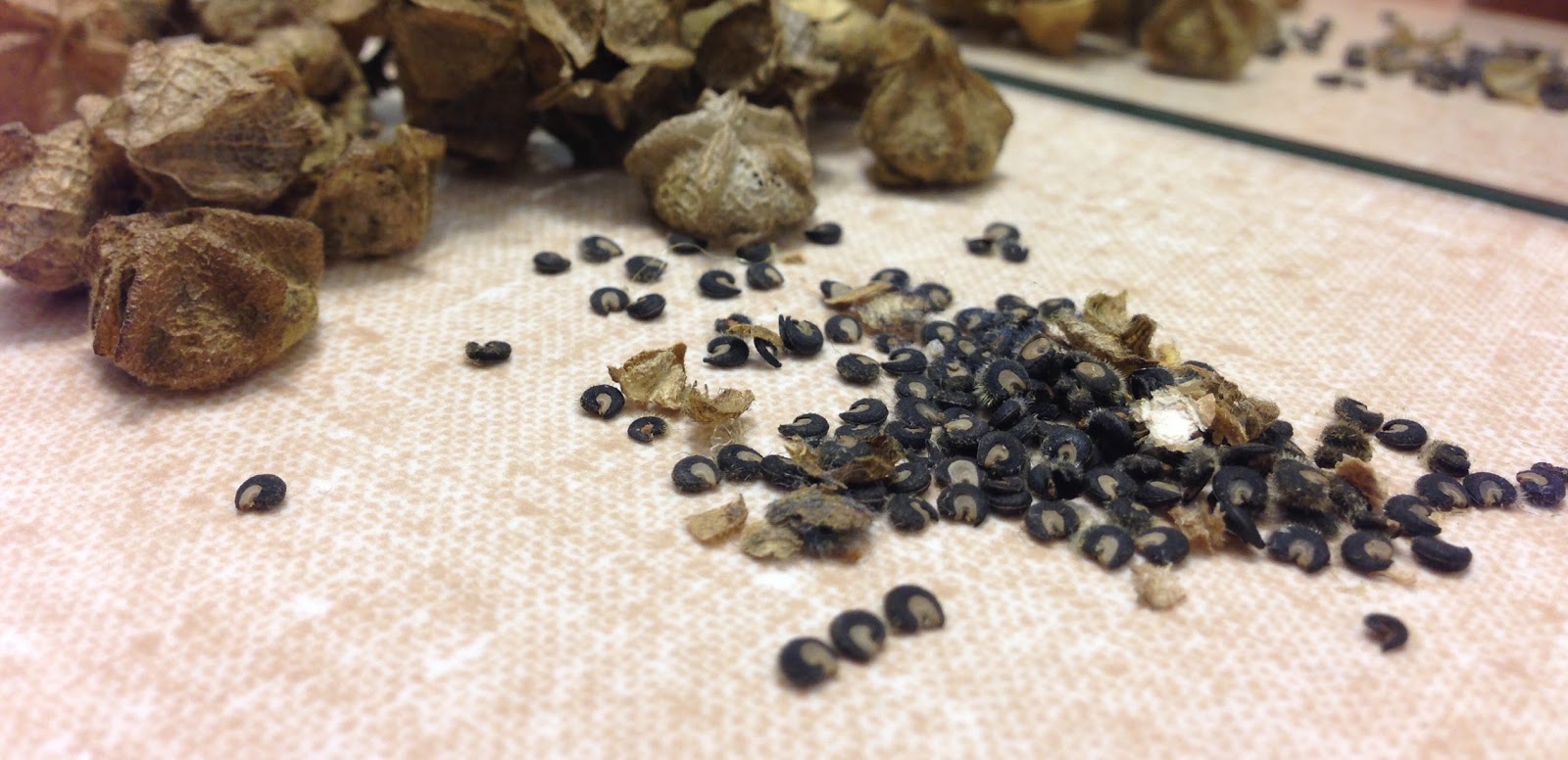
As I walked past a mature asparagus stand, well, I snagged some ripe berries from a female plant to see if I can propagate some from seed.
When I told my best friend about my new found hobby of stealing the genetic offspring of flowers she told me her mother is way ahead of me. Apparently she would go as far as carrying pruning shears and a small hand saw with her when they visited friends' homes. If she saw a plant she wanted she didn't just take seeds that have genetic variation- she took a genetic copy!
I hope I inspire you to look in the flower beds of your neighbourhood and embrace the possibility that it doesn't take any money to garden. In fact, you don't even need your own yard. Take some seeds from one place and guerrilla garden some forgotten corner of your neighbourhood. If you can harvest 10,000 seeds from one plant, even just broadcasting them over depleted soil runs the chance that one of those unique seeds has the genetic make-up to grow, survive, and breed on that bit of ground. And you have taken a small action toward beautifying and re-naturalising an unloved space.
Have a lovely day
 |
| A small weekly harvest from the day neutral strawberries |
Saturday, July 30, 2016
Lessons
Things have been a bit bleak lately. My plums are being massacred by insects, my strawberries are being ripped up by neighbouring horses, my blueberries look like they're burning from the leaf edges, my grapes are stunted.
It's all my fault.
I frequently visit other people's orchards. Usually they are an abandoned side project and I've been proud to see that for the most part my trees look like those in orchards that were planted several years ago. My bubble burst when I visited my best friends who planted their orchard at the same time as I planted mine. Their trees have at least twice as much new wood, three times more leaves, and no apparent evidence of insect damage.
I hated them.
Only briefly. (C'mon, a little jealousy keeps you human!)
Their orchard is very near their house, which allows them to water it daily. They need to. Their soil is sandy and has trouble holding water. Daily water and the endless heat and sunshine that we've had this summer are the perfect recipe for plant growth.
I've started a new job this summer and with the busy whirl of finding my feet in a job that has me travelling around the province I've been neglectful of my orchard. I've only been watering Eden's Rise once a week, sometimes even less. No wonder my trees are being ravaged by insects, curling their leaves up, turning yellow, and my two weakest plants (weak since being planted too early and getting a hard knock by the frost) have finally died.
I realised that far from being on par with those older orchards, I was on the road to having my orchard stunted and looking much as it does now even 4 years from now when ideally I should be in full production. Tough love is not what these young trees need.
Like a procrastinator who has realised the deadline is now only 2 days away I've been pushed into action by panic. I have been watering my orchard every day for 4 days now. To see change overnight seemed too good to be true and yet change is here!
My elderberry plants have added an inch of new wood in 3 days, my plum which had lost 60% of its leaves to insect damaged has now sneezed out a huge tuft of new leaves which totally hides the half eaten massacre within. The blueberries with crusty leaf edges are pushing out some fresh green leaves and the grapes which have been lacking in action nearly all summer have finally sent enough tentacles to reach the first wire of my trellis (about 4 feet) (not all of them, some varieties seem to be struggling more than the rest).
Seeing an immediate result to my extra work is exactly what I needed for morale. I should have known thirsty plants don't have the energy to fight off predators, etc.
Things will be back on track now at Eden's Rise. It may take 2 hours a night to water my orchard, but let's face it. What else would I be doing?
Have a lovely week!
-Eden
Sunday, June 5, 2016
Water on Eden's Rise
Let’s say
you plant an orchard and then the rain doesn’t come. Your orchard does not have
a well, and it is far from the main road. How do you cope?

The Eden’s
Rise solution has been to carry water through the woods to the back acre slice
that is the orchard. It’s not an elegant solution, but a working one until I
can convince the sky to drop some water down into the field and find a way of
collecting it.
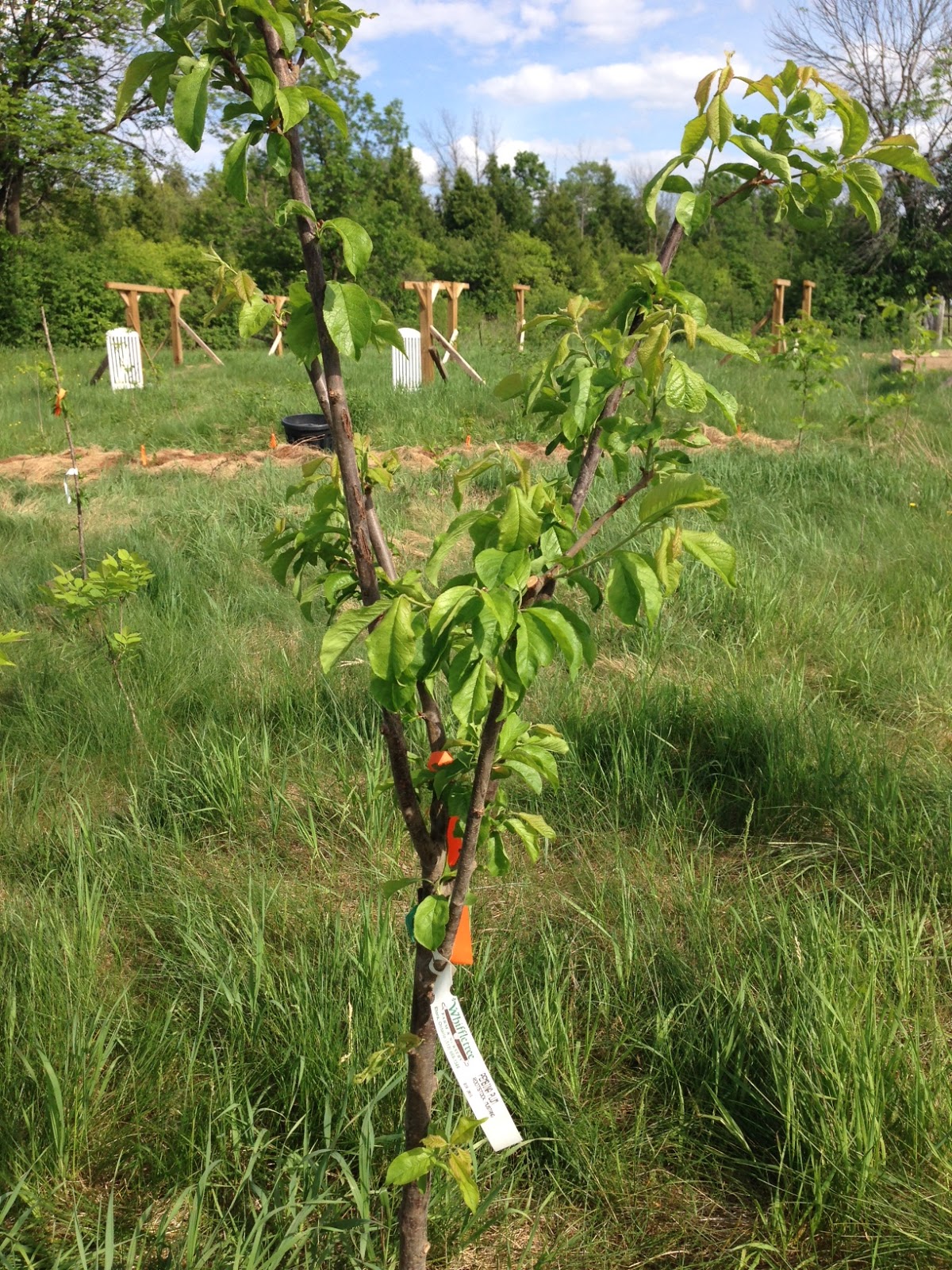
We are
expecting rain today, at last. All the plants are trembling with excitement
(or is that the wind?). As you can probably see from the picture of my plum
tree, the leaves are hanging a little low and look visibly dehydrated. Carrying
water back in a large barrel is all right if you just want your trees to survive,
but I am convinced had they had proper water this past month they would have
grown twice as much. Every day I’ve been worryingly watching the forecast, rain kept disappearing further and further away. I know that I can’t hope to
have my trees strong and healthy if I cannot deliver a proper soaking at least
once a week. The weather for the past two weeks has been hot, dry, and sunny.
Today I am
holding my breath until the rain comes, then I’m counting each drop of rain
like a blessing.
Subscribe to:
Posts (Atom)