Showing posts with label flowers. Show all posts

Tuesday, May 8, 2018

First two weeks of May photo album

Row covers assist with germination and protecting young seedlings.

The micro-climate created beneath row cover keeps the soil warmer and holds in more moisture than bare earth.

A daffodil whose stem was snapped by the wind, now flowering on the kitchen table

Rhubarb plants growing in a composted manure and sand mixture, ready for the market.


Plants ready for transplanting, propagated at home.

Red currants are one of the first plants to open their leaves and flower this spring.

Weeding the orchard is quite an undertaking. Why did I plant so many bushes? Why do I continue planting more?

A new addition to the Eden's Rise team, a man and his machete!

The garden slowly takes shape with a few hours of labour per day. And we're barely keeping up.

A spot for the workers to rest with a cup of tea or a glass of wine. Chairs and 'table' needing replacements. Keeping an eye on the roadside during spring cleaning season for hand-me-downs.

Garlic as of first week of May


Biodiversity in small spaces. This two foot wide patch of dirt between the house and the driveway is capable of providing support to many passing insects.


Haskaps

The greenhouse completed, beds being worked.


Rhubarb, a delicious perennial.

Sunday, October 8, 2017

Gardening for Butterflies

After my last post I received an excellent question: apart from leaving milkweed in my garden, "How else can we encourage the monarchs?"

Milkweed is known to be critical for monarchs as it is the only  plant upon which monarch caterpillars can feed. The adult monarch butterfly however, can feed on any nectar producing flowers. If you want to give them a nutritious pit stop, plant flowers in groups. This allows butterflies to hop from one flower to another using relatively little energy while getting a full meal. 

Here are five great flowers for attracting butterflies.

Coneflower

Purple Coneflower


Aster
Aster


Black Eyed Susan

Black Eyed Susan


Bee Balm

Bee Balm


Lupine

Lupines


This is a beginner's guide as the truth is any flower/plant is useful as a habitat or source of food for an insect. Clumps of grass are great shelter during rough weather, for example. There are flowering charts and extensive lists of flowers and plants that attract butterflies for those who want to be meticulous.  If you aren't interested in having a binder of study material rest assured that having a diversity of plant species is guaranteed to attract winged visitors. Hummingbirds will certainly be attracted by the red flowers of your bee balm.  The only way to go wrong when planning a butterfly garden would be to create a lawn or to use pesticides. 

Biodiversity is the best thing you can offer. Try having perennial flowers that will flower at different times during the season, so that there is always a nectar source. Indigenous weeds are awesome when your gardening budget is low, letting them grow to flower before pulling them up is a great way to create a mini habitat with a huge amount of biodiversity. Indeed, these plant might be host plants for caterpillars from other species of butterflies.

Simply put: have a garden! Your garden is a space you are sharing with wildlife and insects. It is a refuge for these species from the acres of conventional fields and from the pavement and buildings that cover our cities and suburbs. 

Lastly, do them one huge (obvious) favour; don’t cover the plants and soil with pesticides and herbicides. The land might be in your name, but the earth cannot belong to a person. Animals and insects constantly have their food poisoned for something as superficial as a 'perfect' rose bush.

Go forth and make Eden rise! Really, it is that easy.

Sunday, June 25, 2017

Why Does my Tree Only Bear Fruit Every Other Year?

Last summer someone wondered aloud to me that there were not many wild flowers. This year, walking through the forest and wild meadow on the way to the orchard flowers are exploding from the ground, trumpeting life and the air buzzes with insects. I knew that 2016’s drought was a heavy one for our area, but the stark contrast with 2017’s wet spring is shocking.

My fruit trees are growing like fireworks, currant bushes I planted as twigs in May have quadrupled in size. The blueberries I planted this spring have already outgrown the ones that struggled to survive the dry summer. The grass last July was brown and flattened against the earth, now it makes a solid green curtain reaching my navel. It has turned the orchard into a maze where I have to guess the general direction of my Honeyberries to find them. The grass is taller than most of my berry bushes, but they don’t seem to mind. They all have a small radius where I have weeded and mulched the 'root zone'. After all the rain we’ve been having and my application of manure last week the orchard is singing. A monarch butterfly flutters past, floating above the tall grasses and flowering milkweed.

This week I’d like to address a question sent by a reader asking why their apple tree did not flower this year. I commonly get asked about this sort of fruit tree behaviour. The alternate version of the same question is: Why does my fruit tree only bear fruit every other year?

Trees run on a two year cycle when it comes to flowering. Trees want to produce fruit and seeds in order to create offspring. Imagine this year your tree is not producing any fruit. It is going to put a lot of energy into creating flower buds which will be able to produce fruit next year. Fast forward to next year, the tree is loaded with pollinated flowers and it is using all of its energy to ripen its immense load of fruit. This means that during this second year the tree has not been able to invest energy into next year’s flower buds. Year three we are back to a tree with no fruit.

In commercial orchards farmers control the fruit set by spraying the trees (in both conventional and organic agriculture this is a permitted practice, though the chemicals and techniques differ) in order to make them drop two thirds of the potential fruit load. This means the apples, or peaches, or plums that are left on the tree will ripen bigger and more flavourful.  At the home scale you can thin fruit by hand and ladder. My second year working in agriculture I spent a few days in spring thinning fruitlets on peach trees in a greenhouse in northern Ontario.  It is a slow process, but it improves fruit quality and ensures a harvest for next year.

Once trees have gotten used to biennial bearing, it is very difficult to restore them to annual bearing. As far as I am aware it is not impossible, but the ease at which you can bring those trees back is largely affected by how long they have been allowed to bear fruit in this way.

Your berries won't need thinning, they are pretty good at self-regulating. You should thin your grapes to improve flavour. The amount of grapes you leave on depends on the vineyard, the use for the grapes (wine or fresh eating), and the climate. Go with your gut, trust your instinct. Often when it comes to plants the power of observation will lead you to the right place.

Hoping you enjoyed a lovely summer solstice, have a lovely week.

-E.V.

Thursday, May 18, 2017

Spring Begins-- Eden's Rise Year 2

After a week dashing off to my orchard every day after work to plant until sundown, Eden’s Rise is now 160 bushes richer. Currants, blueberries, haskaps, and gooseberries were the primary focus of this planting.

Astonishing numbers of flowers are appearing on last year’s Saskatoon bushes and the asparagus shoots are purple undead fingers pushing out from the earth. Rebirth, baby. Along the pathway in the middle of the orchard Crocus flowers bloomed, then delicate blue Muscaris followed.

The thick layer of coconut coir and dried grass mulch that surrounded every tree and bush has now completely disappeared. This could either be due to a natural process called ‘decomposition’, or, equally likely, garden gnomes stealing it as kindling to light their winter fires. Live and let live, but I will need more mulch if I am to combat weeds and weather. Far from last year’s drought, we began this spring with an unprecedented amount of water, with part of Ottawa heavily affected by floods. Who knows what this summer might bring, but mulch is that magical ingredient that promises to save you from everything. I hope.

It is a comfort, as I begin the long and frankly dull process of gathering and spreading mulch, that last year’s mulch is by now incorporated into the soil around my trees. Some of that mulch is now ‘organic matter’, which is extremely beneficial in the soil. Because the particles are tiny, they wildly increase the water holding capacity of your soil. Organic matter releases nutrients to plants over time and improves the structure of your soil. Even if the gnomes steal 90% of my mulch, at least some of it will have some lasting benefits after disappearing from the surface.

A large pile of horse manure waits to be distributed among the plants this spring. Since this will be applied beneath a layer of mulch (to avoid runoff at the next rainfall) I have my work cut out for me getting all of the trees ready. Once the trees are larger, the mulch will not be necessary. While the trees are young and the roots still finding their way it is important to reduce the amount of weed competition. If you think spreading mulch is boring, I dare you to try to pull grass out of an untilled clay field. I can tell you it is no picnic.

Catnip, onions, and strawberries all survived the winter and have already grown a surprising amount. I am pleased the catnip turns out to be a perennial (I did not do my research before planting; beware, it can become as invasive as mint). I planted catnip because not only does it attracts cats (and who doesn’t want an orchard full of cats?), it is said to repel mosquitoes. Maybe this is just another trick from the Catnip Marketing Board but I think it’s worth trying anything that makes such claims.

These are the first stirrings of life after a long winter!

See you soon!

Monday, October 3, 2016

Hidden gifts

The past few weeks have been wild, both for the garden and for myself. After days of pain I went to the hospital where they kept me for a week and eventually let me leave having confiscated my gallbladder. They said I'd be back at full activity within a week, but no digging or strenuous exercise for two weeks. 

My 300 flower bulbs arrived in the mail the day I went in to the hospital. Poor Eden's Rise, I thought, but lucky me to live in an age where such a surgery can occur so quickly and the wounds can heal and be forgotten almost immediately. It only took four days for walking to become natural again, and I went to see how Eden's Rise fared with my two week absence.

Interesting news: the deer have found the field! Ends of branches have been nibbled off, and entire branches were shaved clean of leaves. Oh what a pickle. 

Having gone through a near death (and if not 'near death', then 'near to wishing for death') experience calms and places things in proportion. 

"The deer had a little to eat, okay, but this year was all about promoting root growth anyway. All those leaves that were eaten weren't important," I tell myself and hope that it is true. "If anything this will be good for the plants as it will encourage them to grow taller branches next year to get out of reach of the deer."

This positive thinking is no reason for inaction, however. I returned home, washed my hair (and let's face it, with my gut still covered in bandages and changing clothes being challenging, washing my hair was somewhat overdue anyway), and then I cut my hair. I placed the cut hair into a bag. Then I brushed my cat's long luxurious coat and collected her fur too. Then I was tired so I had a nap.

Fast forward a bit, now all the trees that had been nibbled in Eden's Rise have a few strands of hair hanging from each branch. 

I am not a hippy!

The smell of soap is a known deer deterrent, as is the smell of humans. I am not sure my cat's fur will deter deer, but who knows, maybe the mice will think twice about gnawing at the bark. 

My two weeks mandatory digging-free rest were over on Saturday, and I planted two thirds of my flower bulbs. On Sunday we had a gentle rain. 

What a glorious time to be alive and healthy. I wish the same to all of you. 

Tuesday, September 6, 2016

Better when it's free

Varieties are important. Apples are a famous example that just because what you planted was a McIntosh seed, doesn't necessarily mean a McIntosh apple tree will grow. In fact, apple seeds are so variable you could plant ten seeds from the same apple tree and get different colours, flavours, and textures from each of the offspring.

Genetics are important in this respect. I do not want to spend time and money caring for a plum tree whose yields might be poor, disease prone, or bitter. I pay a premium to make sure that the genetic stock I have purchased will really be the legendary plumcot and not a random mutation.

However, there are times when genetics are less important. There are some flower species I have been keeping my eye on because they are very attractive for bees, butterflies, hummingbirds, etc. I do not want to grow them for profit, rather I want to grow them because I think Eden's Rise should be about more than pure food production (see previous post), it should also improve the condition of the soil it is on and provide refuge for wildlife displaced by the constant expansion of lawns and car parks. 

Some of the flower species I was looking into buying were already growing in my mother's garden. I noticed from their growth pattern that they propagated underground, a root from the mother plant travelled beneath the surface of the earth and pushed out a fresh plant a few inches away. I asked my mother if in the fall I could dig up some of the baby plants to transplant them in my garden and she happily agreed- some of these plants spread aggressively and need thinning out anyway. A single root from these plants cost $15 in Vesey's catalogue. 


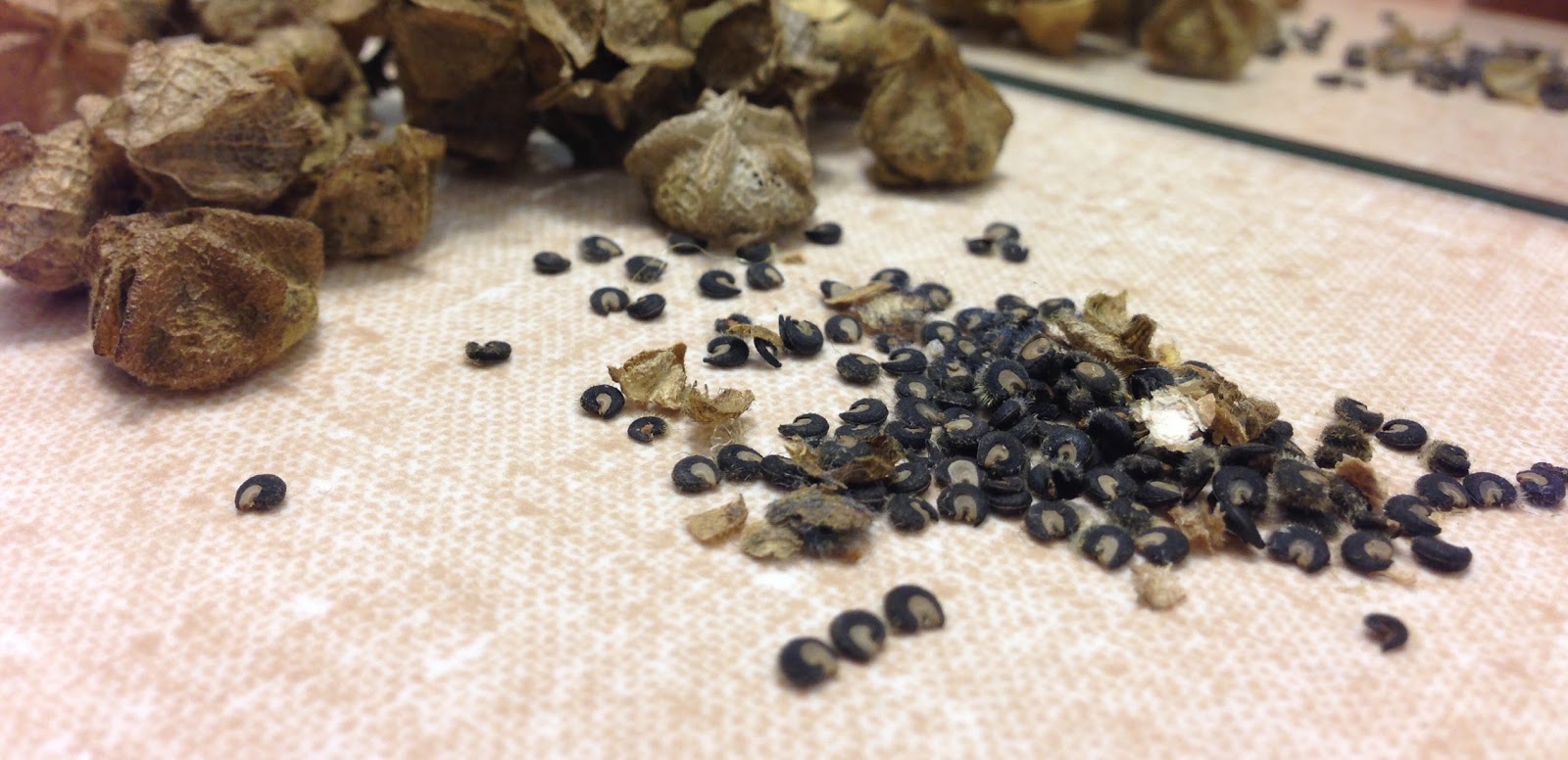
When the phlox flowers died back they revealed dried out seed pods, and when I picked one and tipped it upside down 15 tiny seeds tumbled out. I did a quick google search and found that propagating from seed is not recommended for phlox as the seedling will likely revert to its more wild form- the colour would not be the same as the mother plant. As it happens, that is not important to me in this case! If the bees still love it, the wilder, the better! I folded a sheet of paper that was destined for recycling, taped the edges shut, went back outside and shook each group of seed pods so their seeds rained down into the recycled paper envelop. 

Amazing that a single root would have cost $15 and now I have what must be at least 100,000 seeds! 


Now I am addicted. I love all the lilies in my mom's garden so I have been collecting those seeds too- I might even make little Christmas gifts with them! 

I was up North this week and saw a beautiful flower growing out of the crack in a sidewalk. It happened to have some dried seed pods on one branch. I did some seed sorting in my motel room! 

As I walked past a mature asparagus stand, well, I snagged some ripe berries from a female plant to see if I can propagate some from seed.

When I told my best friend about my new found hobby of stealing the genetic offspring of flowers she told me her mother is way ahead of me. Apparently she would go as far as carrying pruning shears and a small hand saw with her when they visited friends' homes. If she saw a plant she wanted she didn't just take seeds that have genetic variation- she took a genetic copy!

I hope I inspire you to look in the flower beds of your neighbourhood and embrace the possibility that it doesn't take any money to garden. In fact, you don't even need your own yard. Take some seeds from one place and guerrilla garden some forgotten corner of your neighbourhood. If you can harvest 10,000 seeds from one plant, even just broadcasting them over depleted soil  runs the chance that one of those unique seeds has the genetic make-up to grow, survive, and breed on that bit of ground. And you have taken a small action toward beautifying and re-naturalising an unloved space.

Have a lovely day
A small weekly harvest from the day neutral strawberries