Monday, June 12, 2017

You Don't Need a Plastic Bag

You do not need a disposable plastic bag. Not ever.

They can hardly ever be recycled, they do not biodegrade, they have devastating effects on  ocean life. Canadians use 55 million of these PER WEEK. This week’s blog will address the bullshit people tell themselves to justify this disgusting laziness.

1) I forgot my bags in the car.

So what? You are using a trolley in the supermarket, they let you roll this trolley out right to your car. When you’re at the checkout, refuse the bags and put the items back into the trolley. Bring the trolley to your car and empty the items into your bags. There. Was that so  hard? No, it wasn’t. It’s not even worth patting yourself on the back for having done a good thing because this is something you should have started doing years ago.

2) I forgot my bags at home.

See above, except you empty the items into the car and your bags come into play when you get home. I can’t even deal with the “I forgot” excuse. If you forget bags when going to the supermarket, deal with the consequences of your actions and be better next time. Don’t pull this “I’m going to use a plastic bag for 3 minutes because it’s convenient, and let it rot during the course of the next 300 years” crap.

3)Your previous two arguments don’t apply to me because I walk/bike/bus to the supermarket.

Ever heard of a backpack? It will be easier to carry than plastic bags and you have the mental capacity to remember to put a backpack on before leaving your home. If you forgot to bring it, then only buy as much as you can fit in your hands and pockets. Done. Also, good for you for walking! 

4) If I don’t take the plastic bags, what do I use for my garbage bags?

Despite trying to reduce the amount of items I buy which involve packaging, I still end up with a bag full of bags. Here are items that come in bags that you probably throw out all the time, and which could replace the carrier bag: cereal, toilet paper, chips, cat/dog food, bread, potting soil, macaroni, the big bag that the three litres of milk come in. Honestly, we are so inundated with packaging that finding an alternative bag will not be a headache for you. So don’t even with this excuse.

Did I miss any brilliant excuses? Please leave them in the comments section so that I can assure you that there is NEVER a situation in which these ‘convenient’ resource drinking and nature polluting bags are appropriate to use. They should absolutely be banned.

Every time I go to the checkout at my local supermarket I see the same crap being pulled. Two apples in a plastic bag. Someone buying a bag of chips and a box of cereal and for some reason the idea of carrying two items which are already wrapped in plastic to their car without adding another layer of plastic packaging (packaging which will outlive us all) is unthinkable.

Red Currants
I want to live in a world where people who take these bags are heavily judged and receive heavy side eye. I am 100% fed up with this. I cannot remember the last time I used a plastic carrier bag, I hope there will come a time very soon where no one else can remember such utter nonsense either.
Gooseberries
Blueberry Flowers


Oh right, this is a blog about an orchard. How does this relate? Even though it’s a five minute walk from any human house or road, garbage still blows into my orchard regularly. 

Tuesday, May 30, 2017

Wet Noodles in the Garden

Weeding my asparagus patch this weekend was a joy. Weed a foot, celebrate with a spear, weed another foot, munch some more. Have you ever had asparagus fresh from the ground; raw, crunchy, juicy, and sweet? It was a discovery for me that asparagus could be so delicious. It was more reminiscent of fresh ‘mange-tout’ sweet peas than it was of the steamed spears traditionally laid out sparingly and artistically next to a fancy piece of animal flesh. I ate a dozen out there in the field, slowly burning the skin on the back of my neck.

Once these weeds are out of the way, this asparagus spear is my reward!
As I pulled the weeds up through the mulch I was surprised at the number of earthworms at work in there. When I was digging the holes for my new plants this spring I saw very few earthworms, yet here beneath an inch of grass they were having a huge party on the surface of the earth.

Everyone knows worms are meant to be a sign of a healthy soil. I wanted to take a moment of your time to talk about what it is these fleshy noodles actually do.

Worms live in the ground, of course. Like rodents, they like to keep a door to the outside world in their domicile. From this hole they reach out and grab at decaying organic matter. You can see evidence of this in fields where debris is left in the fall. It looks like many consecutive circles, each circle being the territory around a worm’s hole.
They eat this organic matter and defecate in their hole, deeper in the soil. This way nutrients are spread throughout the soil profile. This organic matter, now worm casts, contains nutrients that are more easily available to the plants thanks to Mr. Worm’s digestion.

The tunnels created by the worms also have positive effects. They aerate the soil, and create conditions for better drainage and water infiltration.  The channels also provide an easy avenue in which plant roots can travel deeper in the soil to find further sources of water. Even their wee, noble bodies decompose and provide nitrogen for the plants. A healthy population of earthworms can actually build topsoil, by how much seems to vary from one study to another. This is excellent news for me on my site, where the topsoil is a mere foot before reaching pure bedrock.

I will end on a darker note. The earthworm is not native to Canada. It appears its presence

is having a drastic impact on the ecology of our old growth forests. National parks advise people to avoid dumping left over earthworms from fishing trips in the forest. Take them home, feed them to your dog, just don’t empty that container (even if it is just dirt, they might have laid eggs in there!) in our forests.
Flowering Chum!


Have a lovely week, I wish you good health and happiness!

Thursday, May 18, 2017

Spring Begins-- Eden's Rise Year 2

After a week dashing off to my orchard every day after work to plant until sundown, Eden’s Rise is now 160 bushes richer. Currants, blueberries, haskaps, and gooseberries were the primary focus of this planting.

Astonishing numbers of flowers are appearing on last year’s Saskatoon bushes and the asparagus shoots are purple undead fingers pushing out from the earth. Rebirth, baby. Along the pathway in the middle of the orchard Crocus flowers bloomed, then delicate blue Muscaris followed.

The thick layer of coconut coir and dried grass mulch that surrounded every tree and bush has now completely disappeared. This could either be due to a natural process called ‘decomposition’, or, equally likely, garden gnomes stealing it as kindling to light their winter fires. Live and let live, but I will need more mulch if I am to combat weeds and weather. Far from last year’s drought, we began this spring with an unprecedented amount of water, with part of Ottawa heavily affected by floods. Who knows what this summer might bring, but mulch is that magical ingredient that promises to save you from everything. I hope.

It is a comfort, as I begin the long and frankly dull process of gathering and spreading mulch, that last year’s mulch is by now incorporated into the soil around my trees. Some of that mulch is now ‘organic matter’, which is extremely beneficial in the soil. Because the particles are tiny, they wildly increase the water holding capacity of your soil. Organic matter releases nutrients to plants over time and improves the structure of your soil. Even if the gnomes steal 90% of my mulch, at least some of it will have some lasting benefits after disappearing from the surface.

A large pile of horse manure waits to be distributed among the plants this spring. Since this will be applied beneath a layer of mulch (to avoid runoff at the next rainfall) I have my work cut out for me getting all of the trees ready. Once the trees are larger, the mulch will not be necessary. While the trees are young and the roots still finding their way it is important to reduce the amount of weed competition. If you think spreading mulch is boring, I dare you to try to pull grass out of an untilled clay field. I can tell you it is no picnic.

Catnip, onions, and strawberries all survived the winter and have already grown a surprising amount. I am pleased the catnip turns out to be a perennial (I did not do my research before planting; beware, it can become as invasive as mint). I planted catnip because not only does it attracts cats (and who doesn’t want an orchard full of cats?), it is said to repel mosquitoes. Maybe this is just another trick from the Catnip Marketing Board but I think it’s worth trying anything that makes such claims.

These are the first stirrings of life after a long winter!

See you soon!

Sunday, February 26, 2017

Restoration Agriculture

When I started planning my orchard, I had never heard of Restoration Agriculture, or Mark Shepard.  During the course of the summer when I worked as an organic farm inspector, the words Restoration Agriculture and Mark Shepard kept popping up at the most interesting farms I visited. My personal interests make this a biased ‘most interesting farms’. I love perennial crops. Fruit trees, asparagus, perennial herbs, nuts, and perennial veggies. You get the picture.

What is Restoration Agriculture?
Restoration Agriculture is a way of farming that has the ability to produce many human staple food crops on fields that are unusable to, or have been depleted by annual crop production. It is a way of farming that aims to restore or improve the health of soils, microbiology, wildlife habitats, and waterways that are connected to the production site. How? It relies heavily on imitating the natural ecosystems that were in place before modern man changed the face of the planet. By imitating the indigenous ecosystem of a region, the hope is that we can choose crops that function well in a climate without needing constant attention and coddling.

How do you imitate the natural ecosystem to create a farm? Mark Shepard mainly focuses on the oak savannah at his own farm. To oversimplify things, he has rows of perennial crops with space for cattle to graze beneath. He can grow oak, apple, currants, raspberries, pears, grapes, hazelnuts, and animal flesh and eggs on a hill that if it was under conventional management would be useless for growing corn and could only support a handful of grazing animals. He argues that despite the individual crop yield being lower per acre than a conventional farm, the overall yield if you add the crops together will bring a higher caloric yield than a field equivalent in size that grows corn or soy.

All the while, this system uses no sprays. Animals graze down the grass that competes with the trees and pests are controlled by tree frogs, bats, and ‘good’ insects. Pruning trees is performed by cattle and wild deer. The apples do not all end up looking like the ones in the pyramid display at your local supermarket. The best ones are sold for fresh eating, the rest can be juiced to make delicious cider.

Maybe you’ve started to notice similarities between me and Mark Shepard? Mmm, cider.

Corn needs to be planted, sprayed, weeded, and stalks plowed under every year (despite no-till getting more and more interest). Vegetable crops need to be covered by row covers, hand weeded, or chemically sprayed, protected from insect, frost, wind, and rain damage.  Agriculture is an awful lot of WORK and the returns are not often what anyone would call ‘profitable’. There is one chapter in his book that Mark Shepard begins with the sentence “On the whole, unless someone has special circumstances, nobody is really making any money in agriculture”. He has a few examples of farmers operating at huge losses until they go out of business.  

I don’t want to use sprays on Eden’s Rise, or get too obsessed about things being perfect. I do want it to be an Eden for humans and animals alike. The most exciting moments this summer were when I either got to eat a berry or discovered an amazing new bug or animal in the field.

During the course of my farm inspections I visited a few blueberry farms. One had netting over their entire crop. The farmer explained to me how they had just come up with a new way to set up the netting that took half the time (still several days of labour for the whole team, and that doesn’t include taking it down again), and also complained about being organic because they had to spend 30 hours squishing caterpillars that were ravaging the crop. By contrast, another blueberry farm I visited had no nets, and apparently no pest problems. The farmer said he couldn’t be bothered with the nets, his harvest was able to pay all the bills, and his personal thoughts were that birds prefer protein over sugar. The birds were probably eating as many bugs out of the blueberry plants as they were eating blueberries. When labour is a huge cost in your business, cutting out a useless practice like this could save you a lot of money. Sure, you probably will get a smaller harvest. But a smaller harvest with fewer expenses might actually lead to greater profits.

Mark Shepard also talks about a process of selection whereby he plants a lot of seedling trees and lets the ones who want to die, die, and the resulting trees are strong and capable of surviving his unique environment. Eden’s Rise is only one acre, and I don’t have the capital to get crazy planting thousands of trees and hoping 5 of them will be incredible performers. What I did was similar, albeit I let other people do the work of selecting varieties for me. I planted a wide range of different fruits, and different varieties of the same fruits in order to discover who does well on a shallow, heavy site. I will see what survived the first year and be able to start a second shopping list of the crops and varieties that I will be planting more of in 2018.

If you have any intersecting interest between agriculture and conservation, or an interest in permaculture, I would recommend watching a couple Mark Shepard talks on YouTube. He can be pretty condescending, self-aggrandising, and evasive on the certain subjects, but what I enjoy the most about him is that is stirs in you a new permission to dream up your own way of solving the ‘problems’ of your site without relying on the usual Big Ag expensive ways of ‘fixing’ what doesn’t work for a specific crop.


Have a lovely week!

Tuesday, October 11, 2016

Seven

Fall is a time to take stock. I tried a few things this year and learned a few lessons that will allow me to move forward into more focused plantings.

1.     Asparagus loves my site/soil/climate. Now I am trying to decide how much more to plant next year,  whether I should invest in roots or start plants from seed, and how to prepare the soil in advance for a massive planting.
Asparagus in July. Next spring it will be possible to harvest two spears per plant.
Dwarf cherry, the leaves slowly died
 back until there was only this little
 tuft left. It lives, for now.
2.       Cherries and miniature kiwis are not suited to my site. While the plants still cling to life, the amount of trouble they are having surviving does not bode well. In the spring I will replant these plants in a different area and plant more worthwhile plants in their place. There is no point leaving the prime top-of-the-hill real estate to a group of plants that won’t bear fruit. Better to fill the space with fruit trees that have been doing well.
3.       Plums and apricots are fantastic. More of these will be planted. I love them- they are tough and not many local producers have these crops which means should I ever take them to the farmer’s market I won’t have competition.
4.       Strawberries are delicious, and I am still harvesting in October. There are a lot of strawberry producers in the area, though, so I will keep my production for personal consumption only.
5.       Praying mantises live in Canada! They, along with snakes, love my bit of land and I expect this has to do with leaving tall grasses. I will keep the areas directly below my trees tidy in the future, but will leave wild areas for biodiversity. This will also help wild pollinator species as I want to introduce more species of flowers to those areas.
This red currant produced
DELICIOUS and sweet berries!
6.       Some red currant varieties are delicious and sweet. They bear fruit the second year. I will plant more. Saskatoons taste good and bear the first year, but the skin breaks upon picking. This destroys their potential for even short term storage.
7.       Since the field has no irrigation, there is no point in preparing a vegetable garden with non-drought tolerant crops. Most of my vegetables did not grow. 

love my project. I love that I can make mistakes and learn and always keep dreaming of potential futures the project could have. I was afraid of taking this risk, but it is the most worthwhile risk I have ever taken.

Have a lovely week.

Apricots have beautiful red tinted foliage all summer long.
Munching on grape leaves, this is one fat caterpillar.


Monday, October 3, 2016

Hidden gifts

The past few weeks have been wild, both for the garden and for myself. After days of pain I went to the hospital where they kept me for a week and eventually let me leave having confiscated my gallbladder. They said I'd be back at full activity within a week, but no digging or strenuous exercise for two weeks. 

My 300 flower bulbs arrived in the mail the day I went in to the hospital. Poor Eden's Rise, I thought, but lucky me to live in an age where such a surgery can occur so quickly and the wounds can heal and be forgotten almost immediately. It only took four days for walking to become natural again, and I went to see how Eden's Rise fared with my two week absence.

Interesting news: the deer have found the field! Ends of branches have been nibbled off, and entire branches were shaved clean of leaves. Oh what a pickle. 

Having gone through a near death (and if not 'near death', then 'near to wishing for death') experience calms and places things in proportion. 

"The deer had a little to eat, okay, but this year was all about promoting root growth anyway. All those leaves that were eaten weren't important," I tell myself and hope that it is true. "If anything this will be good for the plants as it will encourage them to grow taller branches next year to get out of reach of the deer."

This positive thinking is no reason for inaction, however. I returned home, washed my hair (and let's face it, with my gut still covered in bandages and changing clothes being challenging, washing my hair was somewhat overdue anyway), and then I cut my hair. I placed the cut hair into a bag. Then I brushed my cat's long luxurious coat and collected her fur too. Then I was tired so I had a nap.

Fast forward a bit, now all the trees that had been nibbled in Eden's Rise have a few strands of hair hanging from each branch. 

I am not a hippy!

The smell of soap is a known deer deterrent, as is the smell of humans. I am not sure my cat's fur will deter deer, but who knows, maybe the mice will think twice about gnawing at the bark. 

My two weeks mandatory digging-free rest were over on Saturday, and I planted two thirds of my flower bulbs. On Sunday we had a gentle rain. 

What a glorious time to be alive and healthy. I wish the same to all of you. 

Tuesday, September 6, 2016

Better when it's free

Varieties are important. Apples are a famous example that just because what you planted was a McIntosh seed, doesn't necessarily mean a McIntosh apple tree will grow. In fact, apple seeds are so variable you could plant ten seeds from the same apple tree and get different colours, flavours, and textures from each of the offspring.

Genetics are important in this respect. I do not want to spend time and money caring for a plum tree whose yields might be poor, disease prone, or bitter. I pay a premium to make sure that the genetic stock I have purchased will really be the legendary plumcot and not a random mutation.

However, there are times when genetics are less important. There are some flower species I have been keeping my eye on because they are very attractive for bees, butterflies, hummingbirds, etc. I do not want to grow them for profit, rather I want to grow them because I think Eden's Rise should be about more than pure food production (see previous post), it should also improve the condition of the soil it is on and provide refuge for wildlife displaced by the constant expansion of lawns and car parks. 

Some of the flower species I was looking into buying were already growing in my mother's garden. I noticed from their growth pattern that they propagated underground, a root from the mother plant travelled beneath the surface of the earth and pushed out a fresh plant a few inches away. I asked my mother if in the fall I could dig up some of the baby plants to transplant them in my garden and she happily agreed- some of these plants spread aggressively and need thinning out anyway. A single root from these plants cost $15 in Vesey's catalogue. 


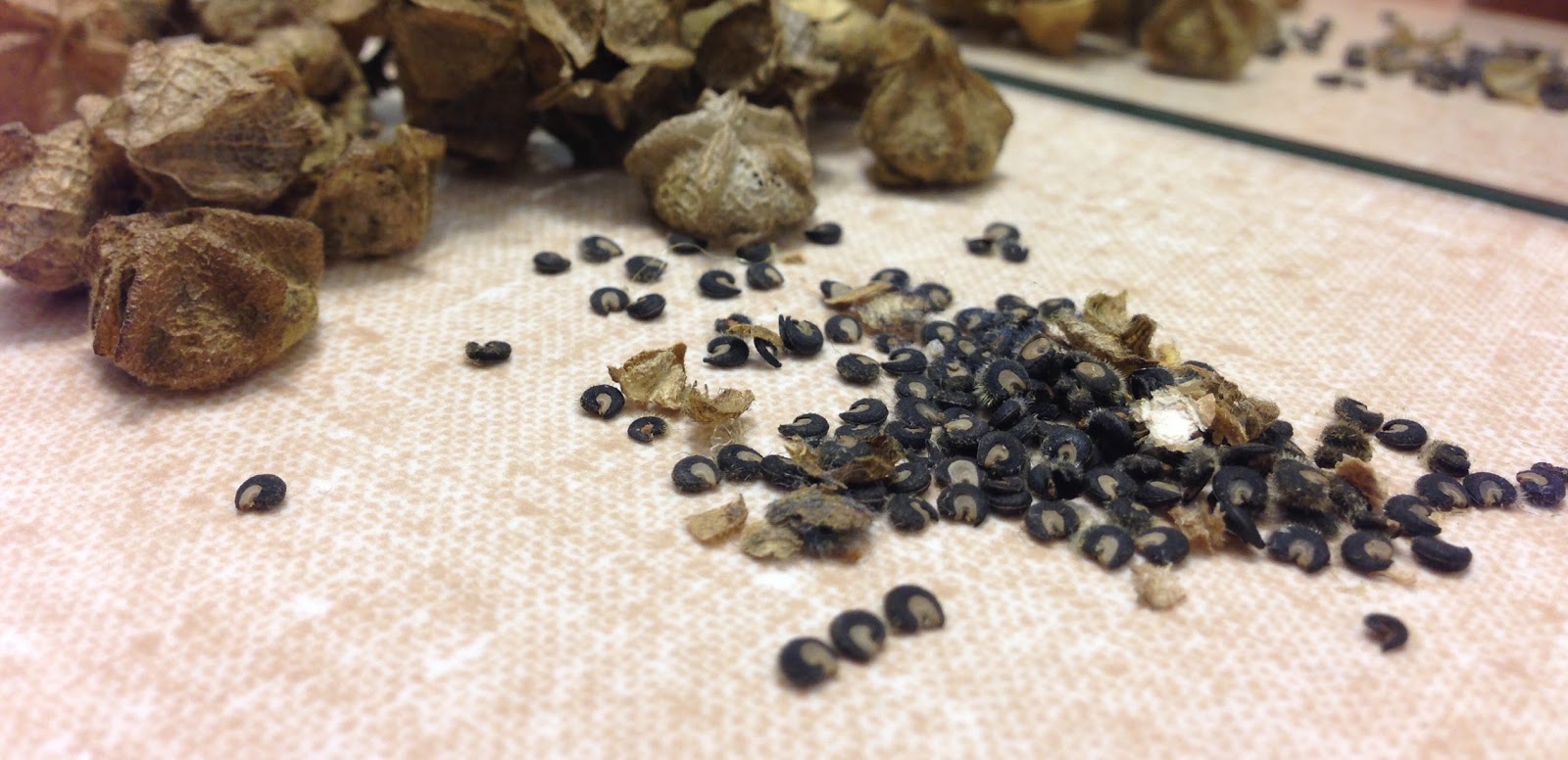
When the phlox flowers died back they revealed dried out seed pods, and when I picked one and tipped it upside down 15 tiny seeds tumbled out. I did a quick google search and found that propagating from seed is not recommended for phlox as the seedling will likely revert to its more wild form- the colour would not be the same as the mother plant. As it happens, that is not important to me in this case! If the bees still love it, the wilder, the better! I folded a sheet of paper that was destined for recycling, taped the edges shut, went back outside and shook each group of seed pods so their seeds rained down into the recycled paper envelop. 

Amazing that a single root would have cost $15 and now I have what must be at least 100,000 seeds! 


Now I am addicted. I love all the lilies in my mom's garden so I have been collecting those seeds too- I might even make little Christmas gifts with them! 

I was up North this week and saw a beautiful flower growing out of the crack in a sidewalk. It happened to have some dried seed pods on one branch. I did some seed sorting in my motel room! 

As I walked past a mature asparagus stand, well, I snagged some ripe berries from a female plant to see if I can propagate some from seed.

When I told my best friend about my new found hobby of stealing the genetic offspring of flowers she told me her mother is way ahead of me. Apparently she would go as far as carrying pruning shears and a small hand saw with her when they visited friends' homes. If she saw a plant she wanted she didn't just take seeds that have genetic variation- she took a genetic copy!

I hope I inspire you to look in the flower beds of your neighbourhood and embrace the possibility that it doesn't take any money to garden. In fact, you don't even need your own yard. Take some seeds from one place and guerrilla garden some forgotten corner of your neighbourhood. If you can harvest 10,000 seeds from one plant, even just broadcasting them over depleted soil  runs the chance that one of those unique seeds has the genetic make-up to grow, survive, and breed on that bit of ground. And you have taken a small action toward beautifying and re-naturalising an unloved space.

Have a lovely day
A small weekly harvest from the day neutral strawberries