Sunday, February 26, 2017

Restoration Agriculture

When I started planning my orchard, I had never heard of Restoration Agriculture, or Mark Shepard.  During the course of the summer when I worked as an organic farm inspector, the words Restoration Agriculture and Mark Shepard kept popping up at the most interesting farms I visited. My personal interests make this a biased ‘most interesting farms’. I love perennial crops. Fruit trees, asparagus, perennial herbs, nuts, and perennial veggies. You get the picture.

What is Restoration Agriculture?
Restoration Agriculture is a way of farming that has the ability to produce many human staple food crops on fields that are unusable to, or have been depleted by annual crop production. It is a way of farming that aims to restore or improve the health of soils, microbiology, wildlife habitats, and waterways that are connected to the production site. How? It relies heavily on imitating the natural ecosystems that were in place before modern man changed the face of the planet. By imitating the indigenous ecosystem of a region, the hope is that we can choose crops that function well in a climate without needing constant attention and coddling.

How do you imitate the natural ecosystem to create a farm? Mark Shepard mainly focuses on the oak savannah at his own farm. To oversimplify things, he has rows of perennial crops with space for cattle to graze beneath. He can grow oak, apple, currants, raspberries, pears, grapes, hazelnuts, and animal flesh and eggs on a hill that if it was under conventional management would be useless for growing corn and could only support a handful of grazing animals. He argues that despite the individual crop yield being lower per acre than a conventional farm, the overall yield if you add the crops together will bring a higher caloric yield than a field equivalent in size that grows corn or soy.

All the while, this system uses no sprays. Animals graze down the grass that competes with the trees and pests are controlled by tree frogs, bats, and ‘good’ insects. Pruning trees is performed by cattle and wild deer. The apples do not all end up looking like the ones in the pyramid display at your local supermarket. The best ones are sold for fresh eating, the rest can be juiced to make delicious cider.

Maybe you’ve started to notice similarities between me and Mark Shepard? Mmm, cider.

Corn needs to be planted, sprayed, weeded, and stalks plowed under every year (despite no-till getting more and more interest). Vegetable crops need to be covered by row covers, hand weeded, or chemically sprayed, protected from insect, frost, wind, and rain damage.  Agriculture is an awful lot of WORK and the returns are not often what anyone would call ‘profitable’. There is one chapter in his book that Mark Shepard begins with the sentence “On the whole, unless someone has special circumstances, nobody is really making any money in agriculture”. He has a few examples of farmers operating at huge losses until they go out of business.  

I don’t want to use sprays on Eden’s Rise, or get too obsessed about things being perfect. I do want it to be an Eden for humans and animals alike. The most exciting moments this summer were when I either got to eat a berry or discovered an amazing new bug or animal in the field.

During the course of my farm inspections I visited a few blueberry farms. One had netting over their entire crop. The farmer explained to me how they had just come up with a new way to set up the netting that took half the time (still several days of labour for the whole team, and that doesn’t include taking it down again), and also complained about being organic because they had to spend 30 hours squishing caterpillars that were ravaging the crop. By contrast, another blueberry farm I visited had no nets, and apparently no pest problems. The farmer said he couldn’t be bothered with the nets, his harvest was able to pay all the bills, and his personal thoughts were that birds prefer protein over sugar. The birds were probably eating as many bugs out of the blueberry plants as they were eating blueberries. When labour is a huge cost in your business, cutting out a useless practice like this could save you a lot of money. Sure, you probably will get a smaller harvest. But a smaller harvest with fewer expenses might actually lead to greater profits.

Mark Shepard also talks about a process of selection whereby he plants a lot of seedling trees and lets the ones who want to die, die, and the resulting trees are strong and capable of surviving his unique environment. Eden’s Rise is only one acre, and I don’t have the capital to get crazy planting thousands of trees and hoping 5 of them will be incredible performers. What I did was similar, albeit I let other people do the work of selecting varieties for me. I planted a wide range of different fruits, and different varieties of the same fruits in order to discover who does well on a shallow, heavy site. I will see what survived the first year and be able to start a second shopping list of the crops and varieties that I will be planting more of in 2018.

If you have any intersecting interest between agriculture and conservation, or an interest in permaculture, I would recommend watching a couple Mark Shepard talks on YouTube. He can be pretty condescending, self-aggrandising, and evasive on the certain subjects, but what I enjoy the most about him is that is stirs in you a new permission to dream up your own way of solving the ‘problems’ of your site without relying on the usual Big Ag expensive ways of ‘fixing’ what doesn’t work for a specific crop.


Have a lovely week!

Tuesday, October 11, 2016

Seven

Fall is a time to take stock. I tried a few things this year and learned a few lessons that will allow me to move forward into more focused plantings.

1.     Asparagus loves my site/soil/climate. Now I am trying to decide how much more to plant next year,  whether I should invest in roots or start plants from seed, and how to prepare the soil in advance for a massive planting.
Asparagus in July. Next spring it will be possible to harvest two spears per plant.
Dwarf cherry, the leaves slowly died
 back until there was only this little
 tuft left. It lives, for now.
2.       Cherries and miniature kiwis are not suited to my site. While the plants still cling to life, the amount of trouble they are having surviving does not bode well. In the spring I will replant these plants in a different area and plant more worthwhile plants in their place. There is no point leaving the prime top-of-the-hill real estate to a group of plants that won’t bear fruit. Better to fill the space with fruit trees that have been doing well.
3.       Plums and apricots are fantastic. More of these will be planted. I love them- they are tough and not many local producers have these crops which means should I ever take them to the farmer’s market I won’t have competition.
4.       Strawberries are delicious, and I am still harvesting in October. There are a lot of strawberry producers in the area, though, so I will keep my production for personal consumption only.
5.       Praying mantises live in Canada! They, along with snakes, love my bit of land and I expect this has to do with leaving tall grasses. I will keep the areas directly below my trees tidy in the future, but will leave wild areas for biodiversity. This will also help wild pollinator species as I want to introduce more species of flowers to those areas.
This red currant produced
DELICIOUS and sweet berries!
6.       Some red currant varieties are delicious and sweet. They bear fruit the second year. I will plant more. Saskatoons taste good and bear the first year, but the skin breaks upon picking. This destroys their potential for even short term storage.
7.       Since the field has no irrigation, there is no point in preparing a vegetable garden with non-drought tolerant crops. Most of my vegetables did not grow. 

I love my project. I love that I can make mistakes and learn and always keep dreaming of potential futures the project could have. I was afraid of taking this risk, but it is the most worthwhile risk I have ever taken.

Have a lovely week.

Apricots have beautiful red tinted foliage all summer long.
Munching on grape leaves, this is one fat caterpillar.


Monday, October 3, 2016

Hidden gifts

The past few weeks have been wild, both for the garden and for myself. After days of pain I went to the hospital where they kept me for a week and eventually let me leave having confiscated my gallbladder. They said I'd be back at full activity within a week, but no digging or strenuous exercise for two weeks. 

My 300 flower bulbs arrived in the mail the day I went in to the hospital. Poor Eden's Rise, I thought, but lucky me to live in an age where such a surgery can occur so quickly and the wounds can heal and be forgotten almost immediately. It only took four days for walking to become natural again, and I went to see how Eden's Rise fared with my two week absence.

Interesting news: the deer have found the field! Ends of branches have been nibbled off, and entire branches were shaved clean of leaves. Oh what a pickle. 

Having gone through a near death (and if not 'near death', then 'near to wishing for death') experience calms and places things in proportion. 

"The deer had a little to eat, okay, but this year was all about promoting root growth anyway. All those leaves that were eaten weren't important," I tell myself and hope that it is true. "If anything this will be good for the plants as it will encourage them to grow taller branches next year to get out of reach of the deer."

This positive thinking is no reason for inaction, however. I returned home, washed my hair (and let's face it, with my gut still covered in bandages and changing clothes being challenging, washing my hair was somewhat overdue anyway), and then I cut my hair. I placed the cut hair into a bag. Then I brushed my cat's long luxurious coat and collected her fur too. Then I was tired so I had a nap.

Fast forward a bit, now all the trees that had been nibbled in Eden's Rise have a few strands of hair hanging from each branch. 

I am not a hippy!

The smell of soap is a known deer deterrent, as is the smell of humans. I am not sure my cat's fur will deter deer, but who knows, maybe the mice will think twice about gnawing at the bark. 

My two weeks mandatory digging-free rest were over on Saturday, and I planted two thirds of my flower bulbs. On Sunday we had a gentle rain. 

What a glorious time to be alive and healthy. I wish the same to all of you. 

Tuesday, September 6, 2016

Better when it's free

Varieties are important. Apples are a famous example that just because what you planted was a McIntosh seed, doesn't necessarily mean a McIntosh apple tree will grow. In fact, apple seeds are so variable you could plant ten seeds from the same apple tree and get different colours, flavours, and textures from each of the offspring.

Genetics are important in this respect. I do not want to spend time and money caring for a plum tree whose yields might be poor, disease prone, or bitter. I pay a premium to make sure that the genetic stock I have purchased will really be the legendary plumcot and not a random mutation.

However, there are times when genetics are less important. There are some flower species I have been keeping my eye on because they are very attractive for bees, butterflies, hummingbirds, etc. I do not want to grow them for profit, rather I want to grow them because I think Eden's Rise should be about more than pure food production (see previous post), it should also improve the condition of the soil it is on and provide refuge for wildlife displaced by the constant expansion of lawns and car parks. 

Some of the flower species I was looking into buying were already growing in my mother's garden. I noticed from their growth pattern that they propagated underground, a root from the mother plant travelled beneath the surface of the earth and pushed out a fresh plant a few inches away. I asked my mother if in the fall I could dig up some of the baby plants to transplant them in my garden and she happily agreed- some of these plants spread aggressively and need thinning out anyway. A single root from these plants cost $15 in Vesey's catalogue. 


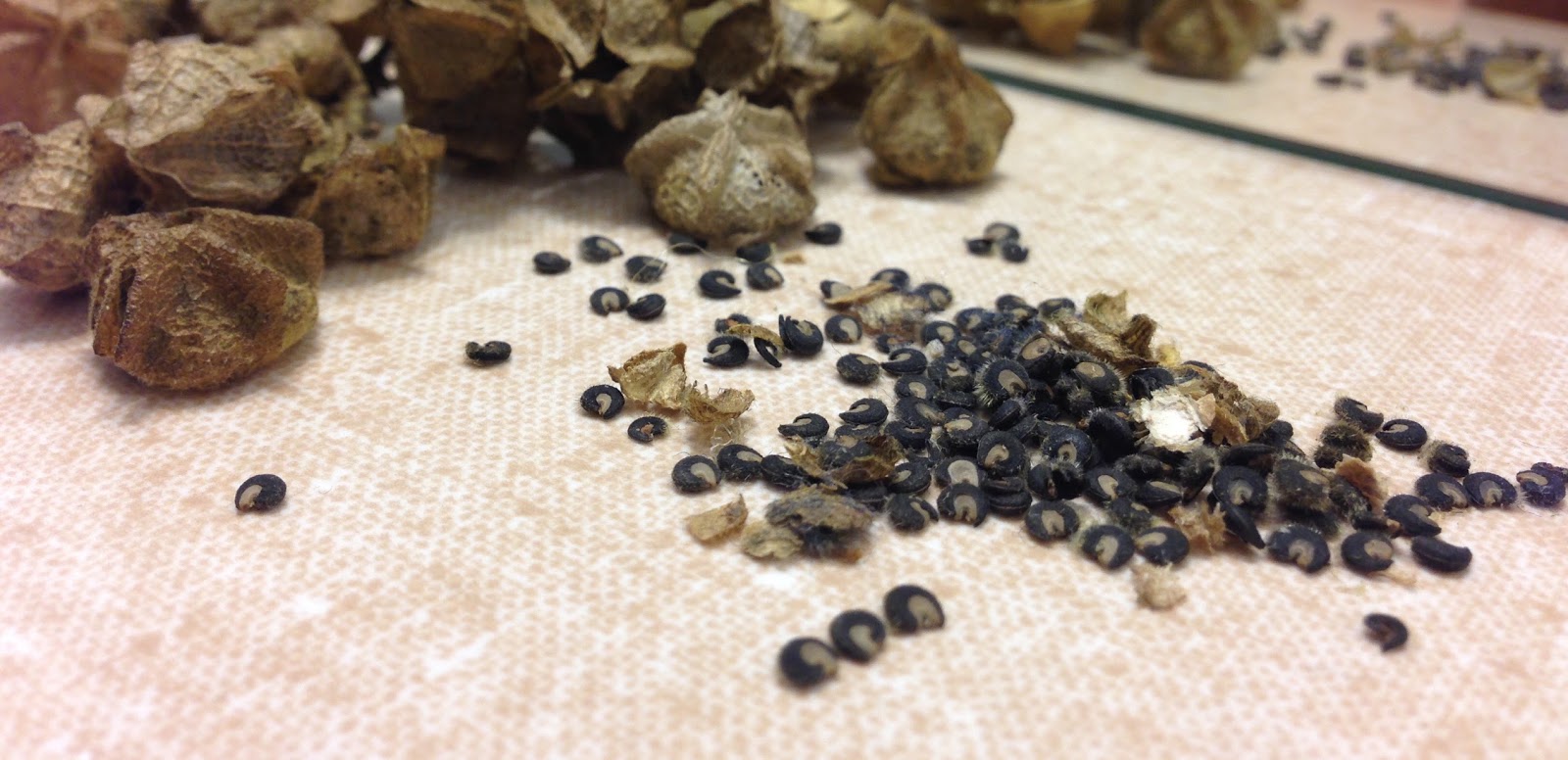
When the phlox flowers died back they revealed dried out seed pods, and when I picked one and tipped it upside down 15 tiny seeds tumbled out. I did a quick google search and found that propagating from seed is not recommended for phlox as the seedling will likely revert to its more wild form- the colour would not be the same as the mother plant. As it happens, that is not important to me in this case! If the bees still love it, the wilder, the better! I folded a sheet of paper that was destined for recycling, taped the edges shut, went back outside and shook each group of seed pods so their seeds rained down into the recycled paper envelop. 

Amazing that a single root would have cost $15 and now I have what must be at least 100,000 seeds! 


Now I am addicted. I love all the lilies in my mom's garden so I have been collecting those seeds too- I might even make little Christmas gifts with them! 

I was up North this week and saw a beautiful flower growing out of the crack in a sidewalk. It happened to have some dried seed pods on one branch. I did some seed sorting in my motel room! 

As I walked past a mature asparagus stand, well, I snagged some ripe berries from a female plant to see if I can propagate some from seed.

When I told my best friend about my new found hobby of stealing the genetic offspring of flowers she told me her mother is way ahead of me. Apparently she would go as far as carrying pruning shears and a small hand saw with her when they visited friends' homes. If she saw a plant she wanted she didn't just take seeds that have genetic variation- she took a genetic copy!

I hope I inspire you to look in the flower beds of your neighbourhood and embrace the possibility that it doesn't take any money to garden. In fact, you don't even need your own yard. Take some seeds from one place and guerrilla garden some forgotten corner of your neighbourhood. If you can harvest 10,000 seeds from one plant, even just broadcasting them over depleted soil  runs the chance that one of those unique seeds has the genetic make-up to grow, survive, and breed on that bit of ground. And you have taken a small action toward beautifying and re-naturalising an unloved space.

Have a lovely day
A small weekly harvest from the day neutral strawberries

Thursday, August 25, 2016

The Farm vs. The Garden

What is a farm and what is a garden?

A farm should be profitable, first of all, and efficient. Straight rows, evenly spaced, soil tilled into a perfect seed bed in order to produce a uniform crop. Orchards are made up of trees in straight lines and the width between the rows reflects tractor size and manoeuvrability as much as it reflects plant requirements. Animals are fed a standard diet and more or less confined to a designated area. There is nothing growing on a farm that does not serve a purpose.

That, at least, is my impression of farms. I love them, and always have. I've worked on loads of farms and dearly wish I had found a nice farm lad to be my husband so that I could live and work on my own farm. 

Don't get the impression that I don't think I am capable of starting and running my own farm without a man involved. Of course I could, and if that's your dream (irregardless of gender or marital status) I encourage you to jump in. 

What is holding me back is that I do not like to limit myself to the analytical thinking required to make a farm efficient and profitable. When I'm at work I'm a huge fan of the "work smarter, not harder" approach, but when it comes to my dreams I want to create a place where food is plentiful, nature is welcome, and puttering is encouraged.

Eden's Rise is a productive garden. Fruit, flowers that are known to be good for wild bees, herbs, and some annual vegetables will all grow here. This year so far I've accomplished three of those four goals, though on a tiny scale. Next year Eden's Rise will be unrecognisable as the little fallow field it once was. 

This fall I am planting 155 more fruiting shrubs and ~200 mixed flower bulbs. In the spring will come ~40 more fruit trees, and possibly some nuts as well. Then, I have a plan for companion planting vegetables, flowers, and herbs below the fruit trees using the permaculture principles of plant guilds. I have begun digging swales and seeding the lower portion in clover to increase soil nitrogen and hopefully the deep roots will break up some of the bedrock. I also need to set about establishing some more permanent raised beds for vegetable and herb production. The raised bed designated for wild flowers will be reseeded again in the spring and hopefully next year a three month long drought will not once again kill all the newly sprouted plants. And all this while trying to plant in a way that is visually appealing. 

Eden's Rise aims to blur the lines between utility and beauty. 

What is a farm and what is a garden? Both are amazing proofs of humanity's ability to influence and change our landscapes and environment. But can a farm be productive and efficient while being beautiful? Can a garden be beautiful while still being efficient and productive? 

Have a lovely week.

Sunday, August 14, 2016

Welcome Mantis, bring your friends

I kept my word and have been watering my plants every evening, when possible. I had to miss a night here and there due to either social events or back pain, but overall my plants have been spoiled these past two weeks and they love it!

I see lots of new wood, new leaves, and the largest surprise of all- a few days after I started regular watering, the insects that were eating the leaves nearly all disappeared. One exception is one apple tree was attacked by several hundred miniature caterpillars, but after a bit of squishing they seem to have disappeared too.

Best of all- it finally rained yesterday. A welcome relief during our summer or drought.

There haven't been many pictures lately of Eden's Rise and that is because of how brown, crispy, and dead the field looks. The only colour comes from my trees and the particularly drought resistant golden rod that has taken possession of the bottom of the field. 

And yet life carries on. I don't know anything about snake life cycles but there are some miniature snakes hanging out near my asparagus and I assume they must be some recent hatchlings. I love snakes, and I am happy that having left the grass long means that they feel comfortable having a habitat in my garden. 

There are also voles, or some kind of fluffy round ball animals. They make holes and run away in a flash of dark fur when I approach them. They don't seem particularly destructive, but I don't appreciate when they make their holes right through the roots of my newly planted trees. They likely don't appreciate me planting trees right through their newly dug holes.

Today I made a new friend: a praying mantis! 


At first I was horrified, all my knowledge about praying mantises came from an episode of Buffy the Vampire Slayer where Xander was nearly eaten by a large Praying Mantis Demon Lady. Still, I had an idea that it was probably not eating my plants and likely even a welcome visitor for my garden. A quick google search when I got home confirmed it. It seems they have enormous appetites for aphids, mosquitoes, caterpillars, and a bunch of other bugs I have no immediate love for. Suddenly I love my new freaky insect friend, and I hope she invites all her friends over for a party! 

Have a lovely week, and take some time to look at nursery catalogues. If you want to start your own orchard or want to plant flower bulbs, then fall is a great time to plant. 


Saturday, July 30, 2016

Lessons

Things have been a bit bleak lately. My plums are being massacred by insects, my strawberries are being ripped up by neighbouring horses, my blueberries look like they're burning from the leaf edges, my grapes are stunted. 

It's all my fault.

I frequently visit other people's orchards. Usually they are an abandoned side project and I've been proud to see that for the most part my trees look like those in orchards that were planted several years ago. My bubble burst when I visited my best friends who planted their orchard at the same time as I planted mine. Their trees have at least twice as much new wood, three times more leaves, and no apparent evidence of insect damage. 

I hated them.

Only briefly. (C'mon, a little jealousy keeps you human!)

Their orchard is very near their house, which allows them to water it daily. They need to. Their soil is sandy and has trouble holding water. Daily water and the endless heat and sunshine that we've had this summer are the perfect recipe for plant growth. 

I've started a new job this summer and with the busy whirl of finding my feet in a job that has me travelling around the province I've been neglectful of my orchard. I've only been watering Eden's Rise once a week, sometimes even less. No wonder my trees are being ravaged by insects, curling their leaves up, turning yellow, and my two weakest plants (weak since being planted too early and getting a hard knock by the frost) have finally died. 

I realised that far from being on par with those older orchards, I was on the road to having my orchard stunted and looking much as it does now even 4 years from now when ideally I should be in full production. Tough love is not what these young trees need.

Like a procrastinator who has realised the deadline is now only 2 days away I've been pushed into action by panic. I have been watering my orchard every day for 4 days now. To see change overnight seemed too good to be true and yet change is here!

My elderberry plants have added an inch of new wood in 3 days, my plum which had lost 60% of its leaves to insect damaged has now sneezed out a huge tuft of new leaves which totally hides the half eaten massacre within. The blueberries with crusty leaf edges are pushing out some fresh green leaves and the grapes which have been lacking in action nearly all summer have finally sent enough tentacles to reach the first wire of my trellis (about 4 feet) (not all of them, some varieties seem to be struggling more than the rest). 

Seeing an immediate result to my extra work is exactly what I needed for morale. I should have known thirsty plants don't have the energy to fight off predators, etc.

Things will be back on track now at Eden's Rise. It may take 2 hours a night to water my orchard, but let's face it. What else would I be doing?

Have a lovely week!
-Eden