Friday, May 25, 2018

Announcement


Eden's Rise is finally in business! This Saturday I will be attending the Metcalfe Farmer's Market selling the following plants:

Strawberries
Rhubarb
Thyme
Winter Savory
Catnip
Mint
Chives
5 varieties of hosta
and more...

I am very excited to see the result of my hard work touch other people's lives. 

To remind you: Eden's Rise is a project with the intention of returning our planet to an Eden-like state of abundance of plant-based foods and habitat for all creatures. One example of how this is being done is in my packaging. Recycled paper pulp baskets will be used for fruit and vegetables during the summer, and all pots that have been used in plant propagation have been donated to me from my community in order to re-use their already existing pots. This way they get another use before going to recycling or landfill and my business does not increase demand for plastic production.

Thank you to the Osgoode community for your generosity, leaving plant pots by my front door throughout the spring. 

Here are some more pictures of the growing vegetable gardens.


Tuesday, May 8, 2018

First two weeks of May photo album

Row covers assist with germination and protecting young seedlings.

The micro-climate created beneath row cover keeps the soil warmer and holds in more moisture than bare earth.

A daffodil whose stem was snapped by the wind, now flowering on the kitchen table

Rhubarb plants growing in a composted manure and sand mixture, ready for the market.


Plants ready for transplanting, propagated at home.

Red currants are one of the first plants to open their leaves and flower this spring.

Weeding the orchard is quite an undertaking. Why did I plant so many bushes? Why do I continue planting more?

A new addition to the Eden's Rise team, a man and his machete!

The garden slowly takes shape with a few hours of labour per day. And we're barely keeping up.

A spot for the workers to rest with a cup of tea or a glass of wine. Chairs and 'table' needing replacements. Keeping an eye on the roadside during spring cleaning season for hand-me-downs.

Garlic as of first week of May


Biodiversity in small spaces. This two foot wide patch of dirt between the house and the driveway is capable of providing support to many passing insects.


Haskaps

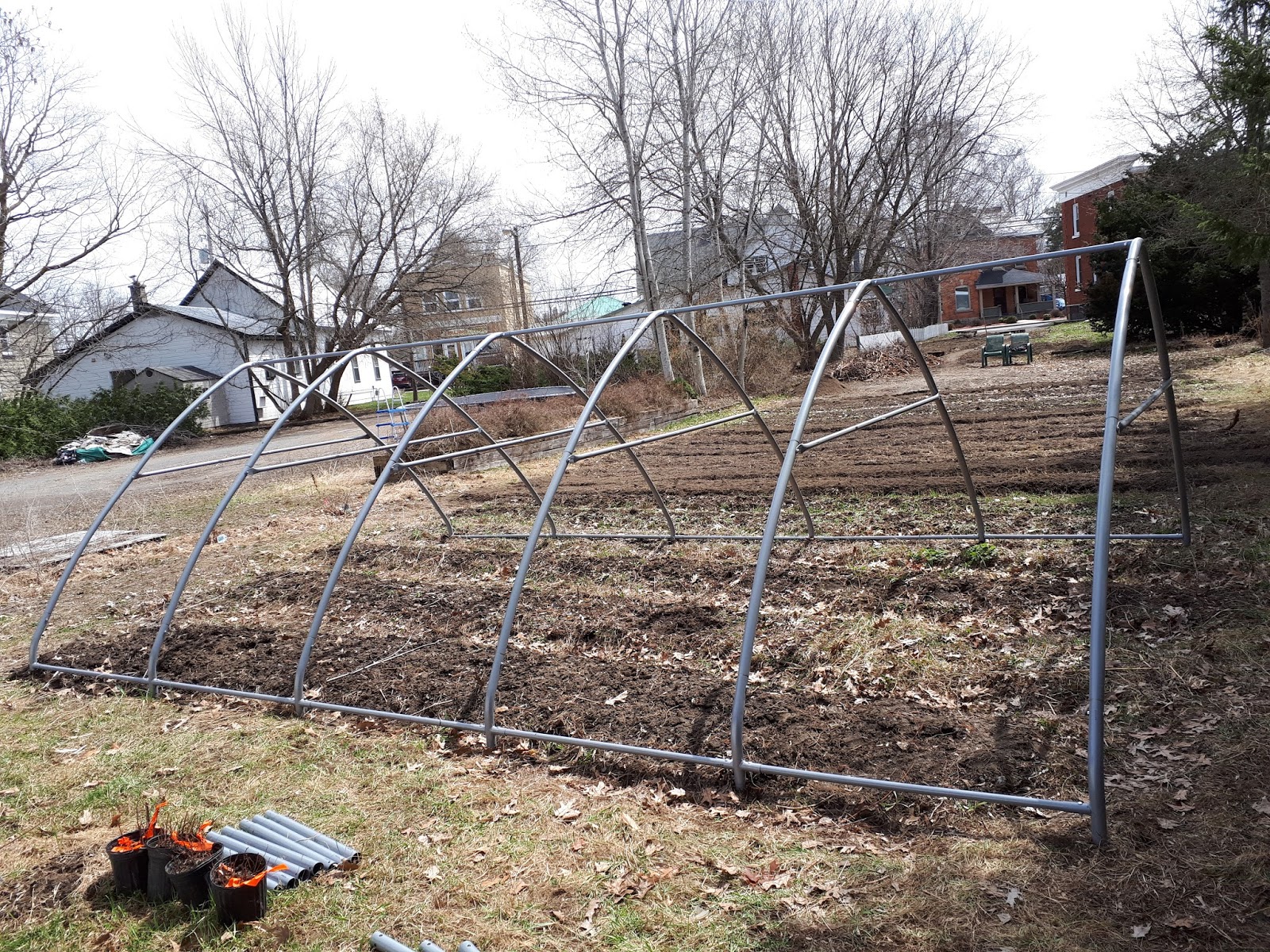
The greenhouse completed, beds being worked.


Rhubarb, a delicious perennial.

Saturday, April 28, 2018

Busy Spring Week update


Digging trenches for asparagus
Asparagus gets buried one foot deep, a few inches at a time


New Strawberry patch at Eden's Rise; urban location. A cat has inspected the bed.
Perennial Herb Border just replanted and expanded


Currants succesfully propagated from cuttings
 have survived the Canadian winter!

Herbs divided 


Four more plum trees in Eden's Rise Orchard


Springtime Mascot


Building a greenhouse


15 yards of compost delivered to urban location


Greenhouse 13'x20'

Rotted horse manure compost delivered 


Wednesday, March 21, 2018

Starting a Market Garden Shopping List

Propagation equipment

  • Seeding cells
  • Seeding trays
  • Growing medium/potting soil mix
  • Heating mats (ideally)
  • Light (ideally)
  • Seeds
  • Labels
  • Permanent marker
  • Notebook for keeping notes and consulting crop plan


Fertility equipment (my soil is very coarse sand)
  • Compost
  • Horse Manure (lowest quality manure, but available for free)
  • Soil
  • Peat moss
  • Pelletized chicken manure or blood meal (ideally)
  • Truck (rent or borrow)


Season Extension equipment
  • Floating rowcovers
  • low tunnel/unheated greenhouse
  • Transplants


Irrigation equipment
  • 150 feet of hose
  • Sprinkler
  • Timer for watering 
  • Drip irrigation for greenhouse crops


Harvest equipment
  • Pulp berry baskets of varying sizes
  • Stackable perforated harvest bins for picking and delivery to market
  • Unperforated bins for washing root vegetables
  • Elastic bands for Asparagus and other bunching vegetables
  • Harvest cart
  • Hose nozzle for cleaning
  • Cold room (ideally)


Market supplies
  • Signs
  • Labels
  • Tent shelter
  • Folding table
  • Table cloths
  • Cashbox
  • Cash & change

Light Your Inner Fuse - Home Want more inspiration? www.inspirecast.caAs I hinted to a few posts ago, I am starting my own market gardening business. My orchard will begin producing small quantities of fruit this year and I will grow annual vegetables. I have started selling houseplants in a local store already and preparing for a busy season as a market gardener. This is all made possible by maintaining a part time job 20 hours per week. Income from the first year can be disappointing as mistakes are made but these are how we learn.

The above is my shopping list for what I need to start my business. This list continues to grow as I remember other indispensable items (feel free to comment anything I have forgotten). I have already purchased many of these items, and am still looking/shopping around for others. Those with "ideally" in brackets are items which I might not get around to purchasing this year.

Risk is inevitable in business. Nothing comes for free, and making a living self-employed requires investment. The returns will hopefully exceed what you can expect as an employee but putting in a few years of hard work is as inevitable as spending some money.

Sunday, March 11, 2018

Minimize that Wardrobe

It is said that we use 20% of our belongings 80% of the time. Despite practicing minimalism for the past year, every week I find more items that have so far evaded my minimizing purges. Every time I think I have nothing left that I could live without, I find myself staring at a piece of furniture or a knick-knack and imagining life without it. Inevitably, it's the next thing I get rid of and the cycle continues.

My 'decluttering' is usually pretty unfocused in nature, and I never developed a system beyond It Must Be Beautiful, Bring Me Joy, or Useful. This system works less well on minimizing a clothing collection. I still have duplicates of black sweaters, farm work jeans, tank tops, etc. 

Until recently I moved every 6 months, and traveled a lot. All my clothes fit in a backpack that wasn't heavy enough to burden me. The climate was not as harsh as Canada, so I didn't need long-johns, snow pants, winter coats, mittens, etc. Mostly I lived in Scotland where summer clothing was equally unnecessary, so no need for summer dresses, multiple bathing suits, or shorts.

Remembering my slightly nomadic existence inspired me to go through my wardrobe as if I still lived that way. Considering my current circumstances I asked of each item of clothing:

If I was going on holiday for several months, somewhere where temperatures ranged from -30C to +30C and I was planning on working on a farm while I was there, would I bring this with me?

It occurs to me that this formula could help others declutter and return clothing into circulation. All you have to do is alter the details within the commas according to what your life and climate look like.

Suddenly it made a lot less sense to hold onto some of the 'just in cases' that have survived monthly clothing purges. 

Perhaps the same trick can help you on your way to living more lightly.


Friday, February 9, 2018

House Plants

Welcome to my home. 

This is one of my three clusters of house plants. In doing research for this post I found some studies that surprised me. The presence of plants has a measurable effect on the happiness and well-being of people. Whether the study involved interacting with plants or being in a room with plants, the effects were measurable even weeks after the initial experience took place. Plants make us feel better. I know that every time I look toward my wall of plants I feel joy, but I never thought science would back me up on this.

Even Meecho gravitates towards the plants
What I expected to find from my research was that plants purify the air. Again, surprise! The science on plants as air purifiers is inconclusive. They do have an effect in laboratory settings, but our homes circulate air so rapidly that their effect in purification might be minimal. Plants do emit humidity, which is good during a Canadian winter. With the house closed off and the heating on, this place can get very dry. I keep adding more plants to protect my cats from getting static electricity shocks to their noses. 

You'll find a million lists of the "9 Most Unkillable Plants" or the "5 Best Air Purifying Plants", so what I wanted to say was what you won't find anyone else saying: You don't have to spend money to get a wall of plants like mine! Plants want to live! They want to grow in all of the spaces. Sure, there will be plant deaths because you over watered one or put a shade loving plant in full sunlight, but with trial and error you can fill your space with plants for minimal investment. Here is how:

1. Get plants. Plants are easy to obtain for free. If you see a plant with branches or vines, just snap a bit off the end of a branch (three inches is enough to work with). When you get home cut the wound open again (as it will have dried out), remove the bottom leaves, and place in a glass of water. Refresh the water after a week and after a couple weeks the plant part will likely be growing roots in that water. 

 All but three of my house plants were propagated from plants of friends, family, fellow gardening club members, a cheeky snip of a plant in a restaurant, or grown from seeds from grocery store-bought fruit.

2. Put them in pots. You can now plant in a pot with soil, or a soilless mix. All of my plant pots were picked up from the side of the road on garbage day, or a friend or co-worker offered them to me when they were cleaning out their garage.The houseplant potting soil is the one of two purchases I have ever made for my house plants (the other being a water-solluble fertiliser but a lot of people don't bother with this). A huge bag of soil mix cost me $9 and I'm not even halfway through using it. 

3. Water. The most common cause of houseplant death is over-watering. A good way to prevent over-watering is to let the plants exhibit signs of wilting. This can trigger flowering in plants that flower. With practice you'll get comfortable with ignoring your plants until they show you stress signs. If a plant looks unhealthy but the soil is wet don't even think about giving it more water! If it looks unhealthy and the soil is dry, go ahead and water.

If you're not sure whether you can spot a healthy plant from an unhealthy plant, don't worry. Get a plant and through trial and error you will learn what it wants.

4. Light. This is pretty tricky. Plants want to be somewhere bright, but not be cooked in direct sunlight. Some like shade, or partial shade, or partial light, or full light. Frankly, they can be pretty picky. My solution to this is to choose a place for the plant and leave it there for 3 weeks. If it looks unhappy and the reason isn't over- or under-watering then I move the plant to a new location that receives either more or less light. Some kinds of plants are very picky and will die quickly. Others just stay stagnant and don't grow until they find the right spot. I have a lipstick plant that stayed the same size for a full year and just grew darker and darker in colour until a couple months ago I finally moved it to a place it likes. Now it is growing lovely bright green leaves and branches. We needed to have patience with each other but finally we can both be happy.

5. Propagate. Now that your plant is happy and growing, take cuttings from the ends of the branches and vines. Or if you have plants like Aloe Vera which make babies that grow from the roots, harvest these babies and put them in their own pot. Grow your army of plants and gift them to friends and family. 

Cover the world in plants!

Saturday, December 30, 2017

Want to Start a Business?

Get fed up.

Every person I've met who has started their own business has done so successfully because they got to the point where they could no longer work for someone else. The reasons for getting fed up vary but it all boils down to the same thing.

Want to start a business?

Get fed up.

Then get to work.